English spelling can trip up even experienced writers, especially when two words sound exactly the same but look completely different on the page. The confusion between staid and stayed is a prime example of this linguistic trap. Writing the wrong one can change the entire meaning of your sentence, turning an observation about someone’s personality into an action about where they spent the night.
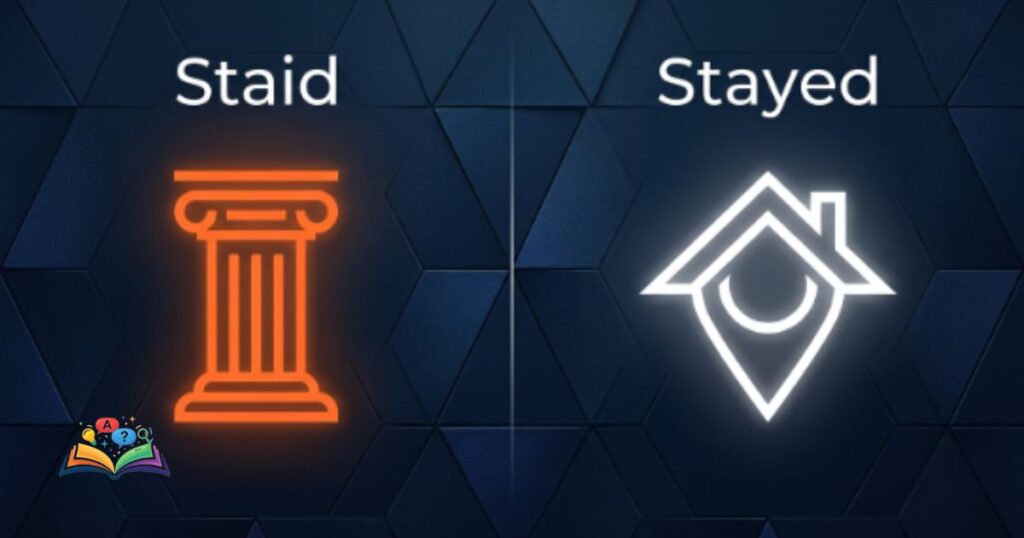
The correct choice depends entirely on whether you are describing a trait or an action. Staid is an adjective used to describe something traditional, sedate, or serious. Stayed is the past tense form of the verb stay, which means to remain in place.
This comprehensive guide clears up the confusion between these two terms. You will see clear definitions, historical context, and practical examples to ensure you always use the right word in your writing.
Decoding the Vocabulary: What Does It Mean to Be Staid or Stayed?
Understanding the grammatical roles of these two words makes it easy to choose the correct spelling. While they sound identical, they serve entirely different functions in a sentence. Look at the breakdowns below to master their distinct meanings.
Breaking Down the Adjective Definition of a Staid Person or Life
Staid is an adjective that describes people, places, or institutions that are sedate, respectable, and unadventurous. If a corporate office has a dull atmosphere, or if a person prefers quiet routines over wild parties, they fit this description. It often carries a slightly negative connotation of being boring or overly old fashioned, though it can also mean stable and reliable.
Tracking the Grammatical Function of Stayed as a Verb Form
Stayed is the past tense and past participle form of the verb stay. It indicates that an action of remaining, lodging, or stopping has already happened. For instance, if you did not leave your house yesterday, you stayed home. This word always denotes an action or a state of being in a specific location over time.
Pronunciation and Etymology: How Do You Say Staid or Stayed and Where Do They Come From?
Both words are pronounced exactly the same way, rhyming with words like “laid” or “paid.” This identical sound is why so many writers accidentally substitute one for the other. However, their histories reveal how they became separate entities in modern American English.
Interestingly, staid actually originated as an archaic spelling of stayed centuries ago. Over time, the spelling with an “i” split off to take on a permanent, specialized meaning as an adjective to describe fixed, sober behavior. Meanwhile, the spelling with a “y” remained attached to the active verb meaning to linger or reside.

Contextual Sentence Examples: How to Correctly Apply Staid or Stayed in Your Writing
Seeing these words in action is the best way to anchor them in your memory. Review the specific use cases below to see how they operate in standard American contexts.
Mirroring Professional Settings Using the Adjective Staid in a Sentence
In business and formal writing, the adjective describes environments or styles that lack modern flashiness.
- Correct: The century-old banking firm maintained a staid corporate culture that resisted technological changes.
- Incorrect: The company had a stayed reputation that bored the younger investors.
Standard Narrative Contexts Using the Past Tense Verb Stayed
When recounting events or tracking where someone spent their time, always use the verb form.
- Correct: We stayed at a historic hotel during our summer vacation in Boston.
- Incorrect: The family staid home during the thunderstorm to watch movies.
Eliminating Spelling Errors: Navigating the Traps of Staid or Stayed or Staied
A frequent mistake in written English is the creation of accidental words like staied. This spelling is completely incorrect and does not exist in standard dictionaries. If you are trying to write the past tense of stay, you must follow the standard rule of keeping the “y” and adding “ed.”
If you enjoy word games, it is helpful to note that staid is a perfectly legal play. It is a highly useful word to keep in mind if you need to secure a victory in your next match. However, if you are looking at a messy layout or trying to fix a text, remember that avoiding common typos is a vital part of clean writing. Just as editors look out for issues like a site or cite mix-up, keeping an eye on your vowel placement here prevents simple mistakes from slipping through.
Advanced Word Confusion: Resolving the Hidden Mix-Up of Stayed or Staid or Stood
The confusion multiplies when speakers mix up stayed with stood. Stood is the past tense of stand, which means to be in an upright position on your feet.
| Word | Part of Speech | Core Meaning |
| Staid | Adjective | Serious, boring, traditional |
| Stayed | Verb | Remained in a place, lodged |
| Stood | Verb | Maintained an upright posture |
In some regional American dialects, people say “I should have stood home,” but this is grammatically incorrect in standard written English. You stand on a corner, but you stay at a hotel. Mixing these up is a common structural error, similar to the way writers accidentally use the wrong term when discussing a role or roll in a script or organization.
Synonyms and Antonyms: Expanding Your Vocabulary Around Staid or Stayed
To improve your writing, it helps to understand the words that share meanings or contrast with our primary terms. A person with a staid demeanor can also be described as solemn, decorous, or straight-laced. The antonyms for this adjective include lively, wild, eccentric, and adventurous.
When looking at the verb side of things, stayed shares a conceptual space with words like remained or lingered. Knowing the slight differences between these terms helps you choose the perfect word for your context. If you want to expand your vocabulary further, take time to study other subtle language distinctions, such as when to use unkept or unkempt to describe a messy appearance.
Final Clarity on the Staid or Stayed Grammatical Dilemma
To keep your writing sharp, use a quick mental trick. Think of the “i” in staid as standing for “inflexible” or “institutional” to represent a stiff, serious personality. Think of the “y” in stayed as standing for “yesterday” to remind you that it is an action that happened in the past.
Mastering these differences is part of building strong communication skills. Navigating tricky word pairs gets much easier once you recognize the patterns. If you want to keep improving your grammar knowledge, check out our comprehensive guide to commonly confused words to keep your writing polished and professional.
Common Questions About Choosing Staid or Stayed
Does Choosing a Staid Lifestyle Mean Your Life Is Entirely Joyless?
Not necessarily. While the word can imply that something is boring or overly conservative, it can also mean that a lifestyle is stable, peaceful, and free from unnecessary drama or chaos.
Is It Grammatically Correct to Use Stayed as an Adjective in Any Scenario?
No. Stayed is strictly a verb form in modern English. If you need an adjective to describe a serious or traditional quality, you must use the spelling staid.
Is Staid a Wordle Word That Is Frequently Used?
Yes, it is a valid five-letter word that has appeared in word games. Players often miss it because the adjective is less common in everyday casual conversation than the verb form.
What Is the Difference Between Stayed Up and Stood Up?
Stayed up means you remained awake past your normal bedtime. Stood up means you rose to your feet, or it means someone failed to show up for a planned date with you.
Can You Say Someone Staid in a Room for an Hour?
No, that is a spelling error. The correct sentence is “Someone stayed in a room for an hour,” because you are describing the action of remaining in a location.