
Many people hesitate when writing stationary or stationery because the words sound exactly alike but have completely different meanings. It is a common spelling confusion in emails, school assignments, office writing, and everyday communication.
One word describes something that is not moving, while the other refers to paper, envelopes, and office supplies. Because only one letter changes, it is easy to pick the wrong one without noticing. Once you understand the meanings and see them in real examples, the difference becomes easy to remember.
This guide explains when to use each word, how to avoid the most common mistakes, and a simple memory trick that helps you choose the correct spelling every time.
The Simple Answer To Stationary Or Stationery
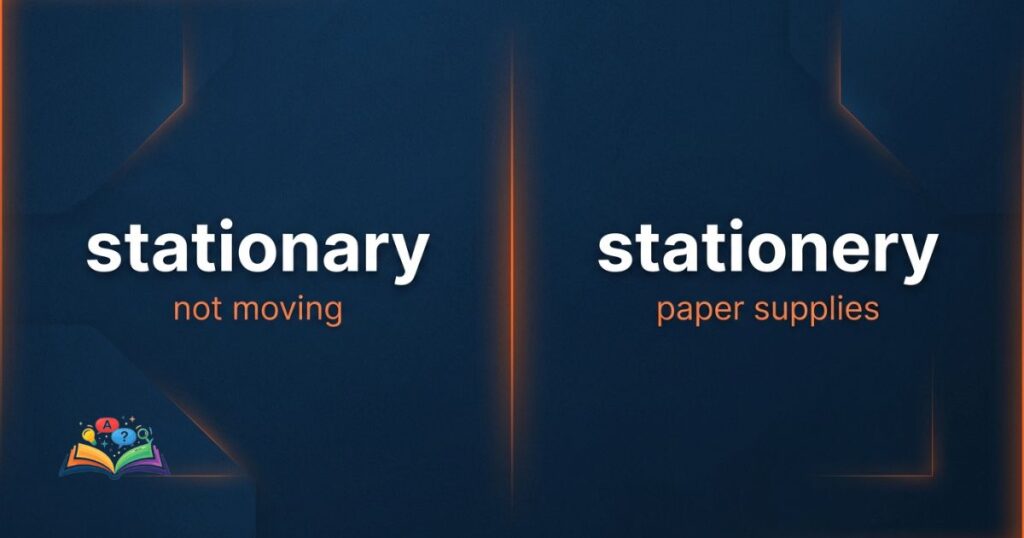
The difference between stationary and stationery is simple:
- Stationary means not moving.
- Stationery means writing paper and office supplies.
For example:
- The car remained stationary at the traffic light.
- I bought new stationery for the office.
English spelling confusions like this happen often, especially when two words sound the same. That is also why many people get confused between prove and proove, where one spelling is valid and the other is not.
Why Stationary And Stationery Cause So Much Spelling Confusion
The confusion between stationary and stationery happens because the words are pronounced the same but spelled differently. Since both appear in everyday writing, it is easy to accidentally choose the wrong one.
They Sound Identical But Have Different Meanings
These words are examples of homophones, meaning they sound the same but have different meanings and spellings.
- Stationary relates to stillness.
- Stationery relates to writing materials.
Because pronunciation does not help, writers rely entirely on spelling. This is the same kind of confusion people face with role and roll differences, where one pronunciation can represent different meanings.
One Letter Changes The Entire Meaning
The only spelling difference is:
- stationary → has a
- stationery → has e
That one letter changes the meaning completely. Similar spelling mistakes happen with roster vs roaster meaning, where just one extra letter creates an entirely different word.
When Stationary Means Not Moving
Use stationary when describing something that is still, fixed, or not in motion.
Examples:
- The bus remained stationary for ten minutes.
- The bicycle was completely stationary.
- His position stayed stationary during the test.
Common Situations Where Stationary Is Correct
You should use stationary when talking about:
- vehicles that are not moving
- objects that remain in one place
- positions that stay unchanged
Examples:
- The train was stationary at the platform.
- The fan looked stationary when switched off.
- Prices remained stationary this month.
Context matters with spelling, and the same is true in waisted vs wasted examples, where one spelling changes the entire sentence meaning.
Example Sentences Using Stationary Correctly
Here are a few more examples:
- The runner stood stationary at the starting line.
- The camera stayed stationary during filming.
- Traffic was stationary after the accident.
These examples show that stationary is always linked to stillness or no movement.
When Stationery Refers To Writing Materials
Use stationery when talking about paper products and office writing supplies.
Examples:
- She bought elegant wedding stationery.
- The office ordered branded stationery.
- He keeps his stationery in a desk drawer.
What Counts As Stationery
Stationery can include:
- writing paper
- notebooks
- envelopes
- pens
- business cards
- letterheads
This kind of word form confusion also appears in parenthesis or parentheses explained, where singular and plural spelling changes the meaning.
Example Sentences Using Stationery Correctly
Here are some correct examples:
- We ordered custom stationery for the business.
- The gift included luxury stationery.
- Her desk was full of colorful stationery.
Whenever the topic is writing materials, stationery is the correct choice.
The E In Stationery Helps You Remember Paper And Envelopes
An easy memory trick can help:
Stationery has an “e” just like an envelope.
Because envelope is part of stationery, the shared e helps you remember the correct spelling.
- stationery
- envelope
Memory shortcuts like this are useful for other spelling confusions too, such as bearable vs bareable spelling guide, where a small spelling difference changes correctness.

Common Mistakes People Make With Stationary And Stationery
The most common mistake is using stationary when referring to office supplies.
Incorrect:
- I bought office stationary.
Correct:
- I bought office stationery.
Using Stationary For Office Supplies
This happens because many people assume stationary is the spelling for paper goods. But this is incorrect.
Remember:
- stationary = not moving
- stationery = writing supplies
Using Stationery To Describe Movement
Another mistake is using stationery for something still.
Incorrect:
- The car was stationery.
Correct:
- The car was stationary.
These kinds of sound-alike errors are common in English, just like peel or peal difference, where pronunciation is the same but meaning is not.
Does Stationary Or Stationery Change In British Or Australian English?
No, the spelling and meaning remain the same in British English, Australian English, and American English.
In all regions:
- stationary means not moving
- stationery means writing materials
The usage does not change by country. Similar grammar concerns often arise in Mondays or Monday’s rules, where punctuation rules stay consistent across English varieties.
Final Clarity On Stationary Vs Stationery
To keep it simple:
- Use stationary for something not moving
- Use stationery for paper and office supplies
Examples:
- The vehicle was stationary.
- I bought new stationery.
If similar spelling pairs often confuse you, reviewing examples like griefing vs grieving usage can improve your word accuracy over time.
Word endings create confusion in many cases, including echoes or echos spelling rules, where one missing letter makes the spelling incorrect.
What People Still Ask About Stationary And Stationery
Is It Stationary Or Stationery For Office Supplies?
Use stationery for office supplies.
Correct:
- We ordered office stationery.
Is Stationary Ever Used For Paper?
No. Stationary is never used for paper or office products.
How Do I Remember The Difference?
Remember:
Stationery has “e” for envelope.