Why “Echoes Or Echos” Confuses So Many People?
You write a sentence like “The sound made many ___” and suddenly pause.
Is it echoes or echos?
It feels like it should be simple. Just add -s, right?
But then you remember words like go → goes or hero → heroes. Now things get messy.
The confusion happens because English doesn’t follow one clean rule. Some words ending in -o take -s, others take -es. And unless you’ve seen the correct form often, both “echoes” and “echos” can look right.
That’s exactly where most people get stuck.
The Correct Plural Of “Echo” And Why It Follows This Rule
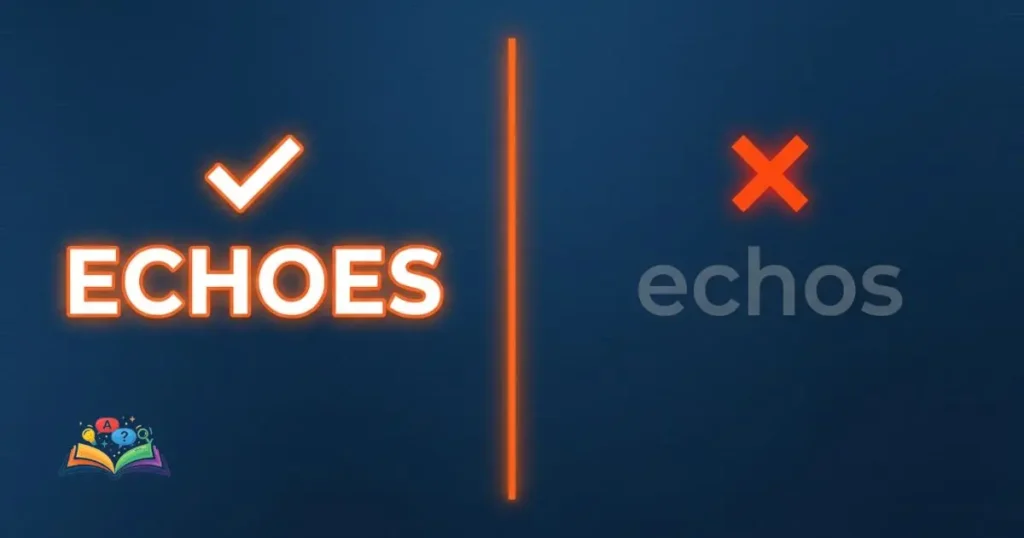
The correct plural of “echo” is “echoes.”
Example:
- The mountains sent back echoes of our voices.
Why?
Because “echo” follows the rule where words ending in -o often take -es to form the plural.
So it becomes:
- echo → echoes
This is the standard, accepted spelling in modern English.
Why “Echos” Looks Right But Isn’t (Most Of The Time)
“Echos” feels logical.
You take a word and add -s. That works for many nouns:
- book → books
- car → cars
So why not:
- echo → echos?
Here’s the issue:
English treats -o endings inconsistently. Some words add -s, others add -es.
Because of that inconsistency, “echos” looks correct but is actually considered incorrect in standard usage.
You might still see it:
- in informal writing
- in typos
- in older or non-standard texts
But for correct spelling, especially in professional or academic writing, “echoes” is the only safe choice.
The Grammar Rule Behind Words Like “Echo”
Here’s the simple version of the rule:
Words ending in -o often form plurals by adding -es, especially when the word comes from Greek or Latin.
Examples:
- echo → echoes
- hero → heroes
- potato → potatoes
But then English breaks its own rule:
- photo → photos
- piano → pianos
So how do you deal with this?
You don’t try to memorize every rule. Instead, you focus on common patterns and familiarity.
Words like “echo,” “hero,” and “potato” are widely used with -es, so they’ve become standard.
When You Might Actually See “Echos” Used
There are a few rare situations where “echos” might appear:
- Brand names or product names
- Usernames or stylized writing
- Informal or incorrect usage online
For example:
- A company might choose “Echos” as a name for style reasons.
But that does not make it grammatically correct.
In proper English writing, “echos” is not the accepted plural.
How To Remember The Correct Spelling Without Thinking Twice

Here’s a quick trick:
Think of this sentence:
“Heroes hear echoes.”
Both words follow the same pattern:
- hero → heroes
- echo → echoes
If you remember one, you remember the other.
Simple, quick, and it sticks.
Real-Life Examples That Make It Obvious
Once you see the word in context, the correct version becomes natural.
- Her voice created soft echoes in the hall.
- The cave returned loud echoes of our footsteps.
- His ideas still echo in my mind. (verb form)
- The sound echoes across the valley. (verb, third person)
Notice something important:
- Echoes is used for both plural noun and verb form
- “Echos” doesn’t fit naturally in any of these
If a word feels awkward in a sentence, it’s usually wrong.
What People Still Get Wrong About “Echoes Or Echos”
Even after learning the rule, a few doubts remain:
1. Is “echos” ever correct?
No. Not in standard English.
2. Is “echoes” only plural?
No. It’s also a verb:
- She echoes his opinion.
3. Why do some -o words take just -s?
Because English borrows from different languages and keeps inconsistent patterns.
4. Should I memorize all -o word rules?
No. Focus on common words like “echo,” “hero,” and “potato.”
The Right Way To Use “Echoes” Going Forward
Here’s the clear takeaway:
- Always use “echoes” as the plural of “echo.”
- Avoid “echos” unless it’s a name or stylistic choice
- Trust what sounds natural in real sentences
If you want to avoid similar confusion, it helps to understand patterns like how plural rules change depending on word endings, just like with other tricky word forms.
Once you’ve seen “echoes” used correctly a few times, your brain stops questioning it.
And that’s the point. No overthinking needed.
Final Clarity On Echoes Or Echos
If you remember just one thing, make it this:
“Echoes” is correct. “Echos” is not.
No exceptions in standard usage. No hidden rule.
Once you lock that in, this confusion disappears for good.
FAQs About Echoes Or Echos
Is it echoes or echos?
It is echoes. That is the correct plural form of “echo.”
Why is it echoes and not echos?
Because “echo” follows the pattern where words ending in -o take -es in plural form.
Can echoes be used as a verb?
Yes. Example: “His voice echoes in the room.”
Is echos ever acceptable in formal writing?
No. It is considered incorrect in standard English.
What is the plural of echo in American and British English?
Both use echoes. There is no difference here.