
If you have ever written “openning” and stopped to wonder whether it was right, you are not alone. This is one of those spelling mistakes that looks believable at first glance, especially because English often doubles consonants before adding -ing. That pattern makes many writers assume open should become openning, but that is not how the word is spelled.
The confusion usually happens because English spelling rules can feel inconsistent. Some verbs double the final consonant, while others do not, and without knowing the rule, it is easy to guess wrong. Similar confusion happens in words like prove or proove, where one version looks acceptable but is actually incorrect.
In this guide, we will explain why opening is correct, why openning is wrong, and how to avoid this mistake in your writing.
Is “Opening” Or “Openning” The Correct Spelling?
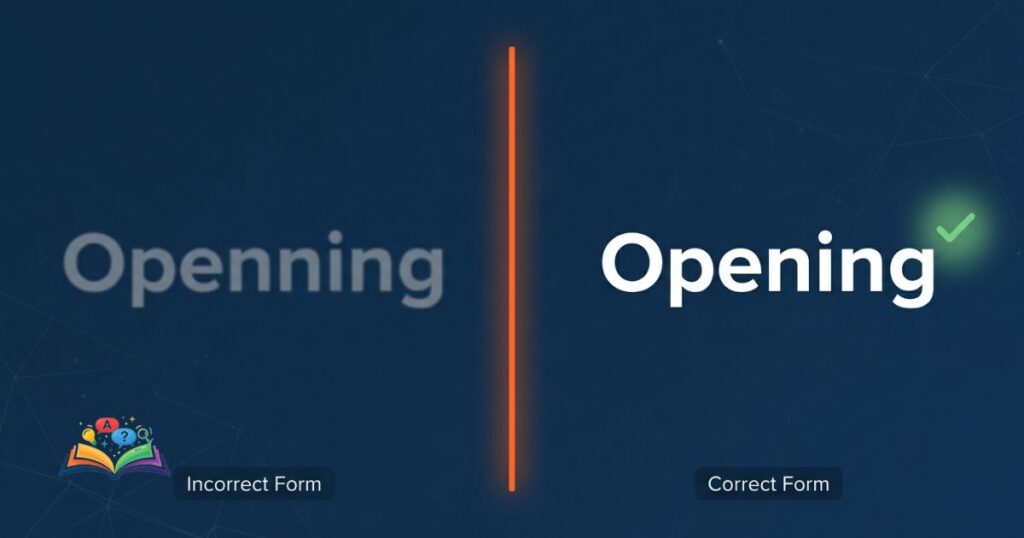
The correct spelling is opening.
The word openning is incorrect and is not recognized as a proper English spelling.
Correct: opening
Incorrect: openning
The word opening is formed by adding -ing to the verb open, without doubling the final consonant. This is where many people get confused, because English sometimes doubles the last letter in words before adding -ing, but not always.
This kind of confusion is common in English spelling. For example, many writers also hesitate between stationary or stationery because both forms look similar but have different meanings.
If you are choosing between opening or openning, always use opening.
Why “Openning” Is A Common Misspelling Of “Opening”
The misspelling openning usually comes from overapplying a spelling rule.
In English, some words double the final consonant before adding -ing:
- run → running
- sit → sitting
- swim → swimming
Because of this pattern, people often assume open should become openning.
But open does not follow that rule.
The same kind of spelling confusion happens in words that look right because they sound familiar, such as bearable or bareable, where writers add letters that do not belong simply because the spelling feels natural.
This is why openning seems correct even though it is not.
Why “Open” Becomes “Opening” Without Doubling The “N”
To understand why opening is correct, it helps to know the doubling rule.
A final consonant is usually doubled before adding -ing only when:
- the word has one syllable, and
- it ends in consonant + vowel + consonant
For example:
- run → running
- sit → sitting
But open has two syllables:
o-pen
Because the stress is not on the final syllable, the n does not double. So:
open + ing = opening
Understanding how words change form is important in English spelling, especially when dealing with variations like parenthesis or parentheses, where endings change based on grammar rules.
Likewise, spelling patterns matter in plurals too, as seen in echoes or echos.
Once you know this rule, opening becomes much easier to remember.
Correct Sentence Examples Using “Opening” Instead Of “Openning”
Seeing the correct spelling in real sentences makes it easier to remember.
Here are some examples:
- The store is having its grand opening tomorrow.
- She spoke during the opening ceremony.
- His opening remarks were brief.
- We watched the opening scene of the movie.
- The opening of the new office was delayed.
In every case, opening is spelled with one n.
Using correct examples is one of the best ways to learn confusing spellings, especially with words that are often mixed up, such as role or roll.
It also helps avoid common usage errors like roster or roaster, where one wrong letter changes the whole word.
The more often you see opening used correctly, the easier it becomes to avoid writing openning.
Common Spelling Mistakes Related To “Opening”
If you misspell opening as openning, you are likely making the same kind of mistakes in other words too.
These errors usually happen when:
- a word sounds different from how it is spelled
- spelling rules are applied incorrectly
- two similar-looking words are confused
For example, many writers struggle with peel or peal because the words sound alike but mean different things.
Others confuse words like waisted or wasted because one form looks familiar even when it is wrong.
Pronunciation can also mislead writers, as shown in griefing or grieving.
Recognizing these patterns can improve your spelling accuracy overall.

The Right Way To Remember “Opening” In Everyday Writing
A simple way to remember the correct spelling is this:
“Open” becomes “opening” with no extra “n.”
Think of the base word:
open
Now add -ing:
opening
No letters need to be doubled.
Building these habits helps prevent everyday mistakes, especially with confusing forms like mondays or monday’s: when apostrophes change spelling.
The more familiar you become with these spelling patterns, the less likely you are to write openning.
Final Clarity On “Opening” Vs “Openning”
The correct spelling is opening, not openning.
The mistake happens because writers assume the final n should double before adding -ing, but open does not follow that pattern.
If you remember that open + ing = opening, you can avoid this common spelling error.
Learning these small rules can make a big difference in your writing, especially when dealing with confusing word pairs.
The next time you hesitate between opening or openning, go with one “n” and choose opening.
Common Questions About “Opening” And “Openning”
Is “openning” ever correct?
No. Openning is always incorrect. The correct spelling is opening.
Why is “opening” spelled with one “n”?
Because open does not meet the rule for doubling the final consonant before adding -ing.
Why do people write “openning”?
Because many verbs double the last consonant before -ing, and writers incorrectly apply that rule to open.
Are there other words like this?
Yes. English has many confusing spellings, including role or roll: other commonly mixed-up English words, where small spelling differences change the meaning.