
If you are unsure whether to use “extravert” or “extrovert,” you are dealing with one of the most common spelling variations in English. Both forms appear correct, but they come from different origins and contexts.
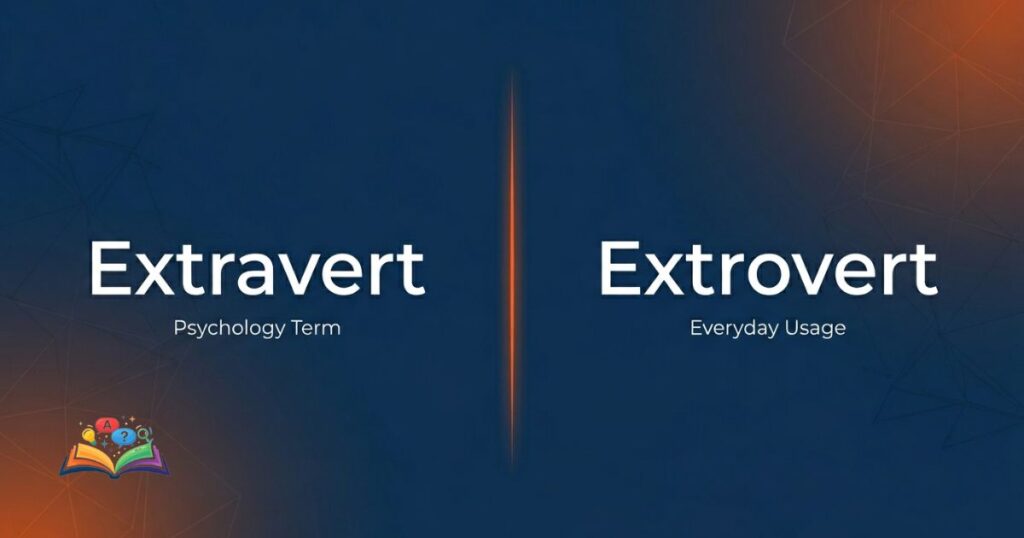
Here is the simple truth: “extrovert” is the more widely used spelling in everyday American English, while “extravert” is the original term used in psychology. This guide breaks down why both exist, when to use each one, and how to stay consistent in your writing.
If spelling confusion shows up often in your writing, this collection of commonly confused English words can help you stay consistent across similar cases.
Why “Extrovert” Became More Popular Than “Extravert” In Modern English
“Extrovert” did not replace “extravert” by accident. It gained traction because it sounds more natural to English speakers and aligns with familiar word patterns. Over time, usage shaped what feels correct.
In American English especially, common usage often outweighs original spelling logic. This shift explains why “extrovert” now dominates casual and professional writing, similar to how confusion happens in pairs like bingeing and binging spelling differences.
Carl Jung’s Original Term “Extravert” And Its Psychological Roots
The spelling “extravert” did not come from modern English trends. It was introduced by Swiss psychiatrist :contentReference[oaicite:0]{index=0} as part of his personality theory.
To understand why this matters, look at how the term was originally defined and why it still appears in academic settings.
How Jung Defined Extraversion In Personality Theory
Jung used “extraversion” to describe people who direct their energy outward toward others and the external world.
- Extraverts gain energy from social interaction
- They focus on external events and environments
- Their behavior is often expressive and action-oriented
This definition still shapes modern personality frameworks today, just like precise definitions matter in word pairs such as parenthesis and parentheses usage rules.
Why Psychology Still Prefers “Extravert” In Academic Contexts
In psychology textbooks and research papers, “extravert” is often preferred because it aligns with the original Latin prefix “extra-,” meaning “outside.”
This spelling keeps the term consistent with related concepts like:
- Extraversion (the trait)
- Introversion (the opposite trait)
In formal writing, consistency with theory matters more than popularity. The same consistency rule applies when choosing between words like griefing vs grieving meaning difference.
Extravert Vs Extrovert In UK And US English Usage Trends
Both spellings exist across English-speaking regions, but their frequency differs depending on location and context.
Understanding regional preferences helps you choose the right form for your audience, much like deciding between commonly confused pairs such as stationary vs stationery differences.
Which Form Is More Common In British English
In British English, both spellings appear, but “extrovert” is still more common in general usage.
However, academic and psychological writing in the UK may still lean toward “extravert” for technical accuracy.
Which Form Dominates In American English
In the United States, “extrovert” is clearly dominant in:
- Blogs and online content
- Workplace communication
- Media and entertainment
“Extravert” appears mostly in academic or psychology-focused material, similar to how usage differences show up in words like flue vs flu spelling confusion.
Extraversion, Extrovert, And Introvert: How These Terms Connect
These terms are often mixed up because they refer to related but different ideas. Knowing how they connect helps avoid confusion in both writing and conversation.
Use the breakdown below to keep each term clear and accurate, just like understanding subtle differences in pairs such as loath vs loathe correct usage.
Difference Between The Trait (Extraversion) And The Person (Extrovert/Extravert)
- Extraversion: A personality trait describing outward-focused energy
- Extrovert/Extravert: A person who shows that trait
Example:
- Correct: She scored high in extraversion.
- Correct: He is an extrovert in social settings.
The Spectrum Between Introvert And Extrovert Personalities
Personality is not binary. Most people fall somewhere between introvert and extrovert.
This middle ground is often called “ambivert,” describing people who:
- Enjoy social interaction but also need alone time
- Adapt their behavior based on the situation
Common Mistakes When Using Extravert Or Extrovert In Sentences
Writers often mix these spellings without realizing it. This creates inconsistency and weakens clarity.
Watch for these common issues:
- Switching between “extravert” and “extrovert” in the same article
- Using “extraversion” but pairing it with “extrovert” inconsistently
- Assuming one spelling is incorrect, when both are accepted
Consistency matters more than preference. Pick one form and stick with it, just like avoiding confusion in pairs such as waisted vs wasted differences.
Real-World Sentence Comparisons Using Extravert And Extrovert
Seeing both spellings in context makes the distinction clearer. The examples below show how each form works depending on the situation.
Professional And Academic Sentence Usage
- The study focused on extravert behavior in group dynamics.
- Participants with high extraversion scores responded faster.
These examples reflect formal and research-based writing.
Informal And Conversational Sentence Usage
- She is an extrovert who loves meeting new people.
- I am more of an introvert than an extrovert.
These examples match everyday American English. If you want more clarity on everyday word confusion, comparing terms like roster vs roaster differences can sharpen your understanding.
Quick Self-Check: Are You More Of An Extravert Or Extrovert Personality?
Personality labels are useful, but they are not rigid categories. A quick self-check can give you a rough idea of where you fall.
Ask yourself:
- Do you feel energized after social interaction?
- Do you prefer group activities over solo time?
- Do you speak first or reflect first in conversations?
If most answers lean toward social energy, you likely show extroverted traits, similar to how recognizing patterns helps avoid mistakes like unkept vs unkempt correct spelling.
Final Clarity On Extravert Or Extrovert And Which You Should Use
Here is the final takeaway:
- Use “extrovert” for general writing, blogs, and everyday communication in the US
- Use “extravert” for psychology, academic work, or when referencing Jung’s theory
Both spellings are correct. The difference comes down to context and audience. This same principle applies when choosing between confusing terms like peel vs peal meaning and usage.
Common Questions About Extravert Or Extrovert
Is “Extravert” The Technically Correct Spelling?
Yes, “extravert” is technically correct based on its Latin root and original use in psychology by Carl Jung.
Why Do Dictionaries Accept Both Extravert And Extrovert?
Language evolves through usage. As “extrovert” became more common, dictionaries accepted it as a standard variant.
Is “Extrovert” Wrong In Academic Writing?
It is not wrong, but “extravert” is often preferred in psychology and academic contexts for consistency with theory.
Which Version Should I Use For SEO And Content Writing?
Use “extrovert” for SEO-focused content in the US because it matches common search behavior and user expectations.
Can I Use Both Spellings In The Same Article?
It is better to avoid mixing them. Choose one spelling based on your context and stay consistent throughout.