If you are unsure whether to write loath or loathe, the difference is not just spelling, it is grammar. These two words look nearly identical but belong to different parts of speech and carry different meanings.
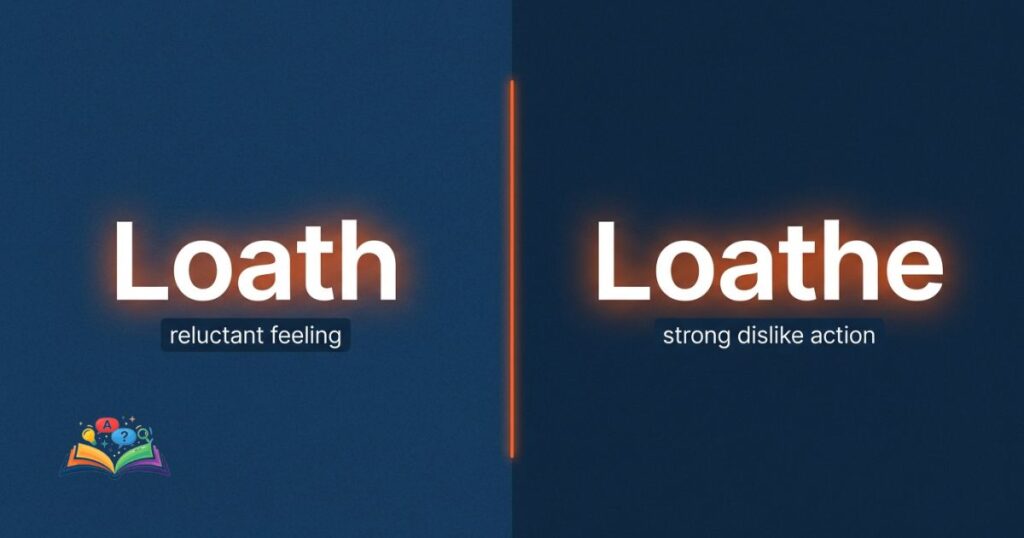
In short, loath is an adjective meaning reluctant, while loathe is a verb meaning to strongly dislike. This article breaks down when to use each one, why people confuse them, and how to avoid mistakes in everyday writing.
Why “Loath” And “Loathe” Sound Similar But Function Differently In English Grammar
These two words often get mixed up because they sound almost the same in casual speech. That similarity hides an important grammatical difference that changes how each word behaves in a sentence.
To avoid confusion, focus on how each word functions. The sections below break it down clearly.
Pronunciation Overlap And How It Triggers Misuse
In American English, loath and loathe are pronounced very similarly. The subtle “th” sound at the end can blur together in fast speech.
This leads to writing errors like:
- ❌ I am loathe to go
- ❌ She is loathe to admit it
Both are incorrect because the verb form is being used where an adjective is needed.
Adjective Vs Verb: The Core Grammatical Divide
The real difference is grammatical role:
| Word | Part Of Speech | Meaning | Example |
| Loath | Adjective | Reluctant, unwilling | I am loath to sign the contract |
| Loathe | Verb | To strongly dislike | I loathe long meetings |
Once you recognize this distinction, most confusion disappears.
How “Loath” Functions As An Adjective In Formal English
Loath is typically used in more formal or careful writing. It appears most often after linking verbs like “am,” “is,” or “are.”
Common structure:
- I am loath to comment
- He is loath to change his position
This pattern is fixed. You will rarely see loath used outside of this structure.
Compare:
- ✅ I am loath to get involved
- ❌ I loath getting involved
The second sentence is incorrect because it tries to use loath as a verb.
When To Use “Loathe” Correctly To Express Strong Dislike
Loathe is an action word. It shows strong emotion, often stronger than “dislike.”
Examples:
- I loathe doing taxes
- She loathes dishonesty
- They loathe waiting in long lines
Notice how loathe works like any other verb:
- Present: loathe / loathes
- Past: loathed
- Continuous: loathing
Incorrect usage to avoid:
- ❌ I am loathe doing this
- ❌ He is loathe loud music
In both cases, the verb form is needed instead.
“I Am Loath Or Loathe”: Breaking Down This High-Confusion Phrase
This phrase causes confusion because it mixes a linking verb with two similar-looking words. The correct choice depends on grammar, not just meaning.
Here is the clear rule.
- ✅ I am loath to leave early
- ❌ I am loathe to leave early
Why? Because “am” requires an adjective, not a verb.
Now compare:
- ✅ I loathe leaving early
Here, loathe works because it acts as the main verb.
A quick fix:
If your sentence includes “am,” “is,” or “are,” you almost always want loath, not loathe.
Loath Vs Loathe In UK And US Usage: Is There Any Difference?
There is no meaningful difference between US and UK usage for loath and loathe. Both forms follow the same grammatical rules in standard English.
However, loath is less common in casual American writing. Many people replace it with simpler phrases like:
- reluctant
- unwilling
Still, in formal writing, exams, or professional communication, loath remains correct and appropriate.
If you are working on other tricky word pairs, this guide on common English mistakes explained simply covers similar patterns.
Real Sentence Comparisons That Show Loath Vs Loathe In Action
Seeing both words side by side makes the difference much clearer.
| Incorrect Sentence | Correct Sentence |
| I am loathe to call him | I am loath to call him |
| She loath public speaking | She loathes public speaking |
| They are loathe to decide | They are loath to decide |
| I loath cold weather | I loathe cold weather |
More examples:
- I am loath to interrupt the meeting
- I loathe being interrupted
If you struggle with similar word confusion, you might also run into pairs like stationary vs stationery usage or role vs roll explained clearly, which follow similar patterns.
Grammar Rules And Memory Tricks To Avoid Mixing Up Loath And Loathe
This confusion is easy to fix once you use a simple memory approach. Keep these quick rules in mind.
Quick Memory Tricks
- Loath = ends short, used after “am,” “is,” “are”
- Loathe = longer, works like a verb
Think of it this way:
- “E” at the end = action word

Spotting Errors Instantly
Look for these red flags:
- “I am loathe…” → usually wrong
- Missing verb form like “loathes” → likely incorrect
Practice helps. If you can spot patterns in other confusing pairs like grieving vs griefing differences or peel vs peal explained, this one becomes much easier.
Final Clarity On Loath Vs Loathe Usage In Modern English
The confusion between loath and loathe comes down to one thing, grammar. One is an adjective, the other is a verb.
- Use loath after “am,” “is,” or “are”
- Use loathe when expressing strong dislike
Once you separate structure from sound, the mistake becomes easy to avoid. The same approach works for other confusing word pairs like parenthesis vs parentheses explained or flue vs flu differences.
Common Questions About Loath Or Loathe
Is “I Am Loathe” Ever Correct?
No. “Am” requires an adjective, so “I am loath” is correct. “Loathe” is a verb and does not fit in that structure.
What Does “Loath” Mean In Simple Terms?
It means unwilling or reluctant. For example, “She is loath to admit she was wrong.”
Can “Loathe” Be Used As An Adjective?
No. “Loathe” is strictly a verb. It cannot describe a state like an adjective can.
Why Do People Confuse Loath And Loathe So Often?
They sound almost identical in speech, which leads to incorrect assumptions when writing.
Is “Loath” Common In Everyday American English?
Not very common in casual speech. Many people use “reluctant” instead, but “loath” is still correct in formal contexts.