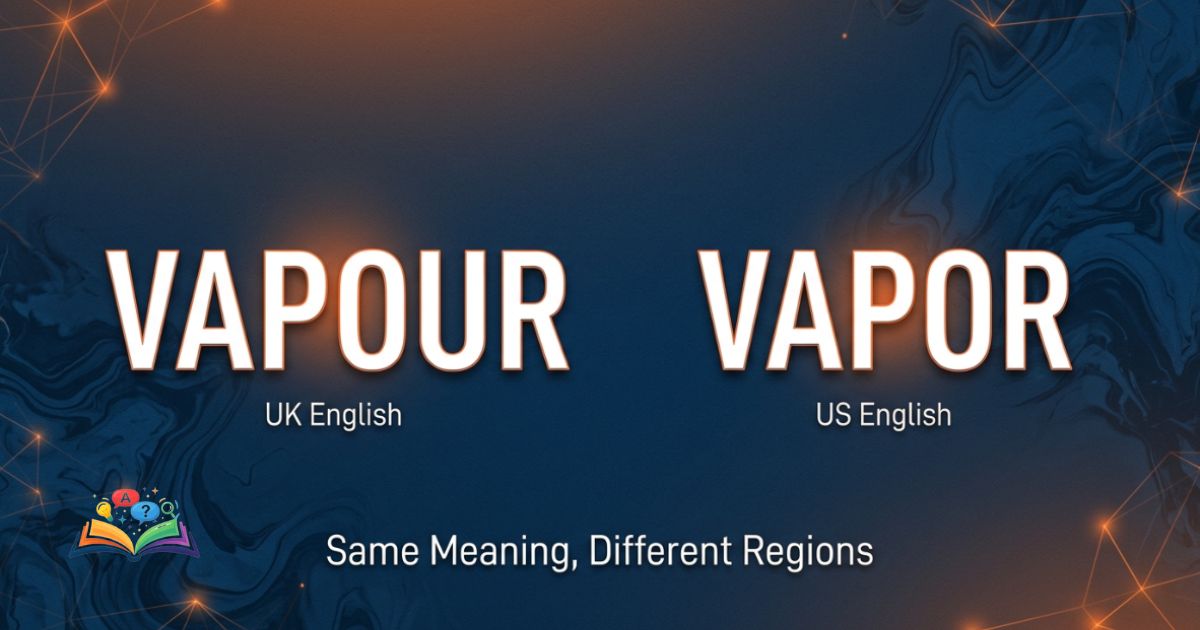
If you’ve seen both vapour and vapor, you may have wondered which spelling is correct. The answer is simple: both are correct, but they belong to different versions of English. In American English, vapor is the standard spelling. In British English, vapour is preferred.
This spelling difference is similar to other well-known variations such as color vs. colour, where the meaning stays the same but the spelling changes depending on the region. This guide explains why both spellings exist, where each is used, and how to choose the right version for your audience.
Why Vapour And Vapor Are Different Spellings Of The Same Word
Vapor is the correct spelling in American English, while vapour is the correct spelling in British English. Both words describe a substance in its gaseous state, especially one produced from a liquid or solid. The meaning, pronunciation, and scientific definition are identical. The only difference is regional spelling preference.
The distinction comes from historical spelling reforms that simplified many British spellings in the United States. Similar patterns appear in other words discussed in this guide to British and American English differences.
| American English | British English | Meaning |
| Vapor | Vapour | Gas or gaseous substance |
| Color | Colour | Hue or shade |
| Honor | Honour | Respect or admiration |
| Fiber | Fibre | Thread-like material |
Vapour Vs Vapor Across English-Speaking Countries
The spelling you choose largely depends on where your readers are located. Different countries follow different spelling conventions.
| Country | Preferred Spelling |
| United States | Vapor |
| Canada | Vapour (more common) |
| United Kingdom | Vapour |
| Australia | Vapour |
| New Zealand | Vapour |
American publications, schools, scientific organizations, and businesses almost always use vapor. British and Commonwealth countries generally use vapour.
This follows the same regional pattern seen in honour or honor and fibre or fiber.
Is It Water Vapour Or Water Vapor?
Both phrases are correct, but the preferred spelling depends on the audience.
For American readers:
- Water vapor ✔
- Water vapour ✖ (uncommon in US writing)
For British readers:
- Water vapour ✔
- Water vapor ✖ (less common)
Water vapor refers to water in its gaseous form. It is invisible and exists naturally in the atmosphere.
Examples
- Warm air can hold more water vapor.
- Water vapor contributes to cloud formation.
- Scientists measured the amount of water vapor in the atmosphere.
How Vapour And Vapor Are Used In Chemistry And Science
In science, both spellings refer to the gaseous phase of a substance that is normally liquid or solid at room temperature.
Scientific journals generally follow the spelling style of their publisher or country. American scientific publications usually use vapor, while British publications often use vapour.
Examples include:
- Vapor pressure
- Vapor density
- Vaporization
- Water vapor content
Even when the spelling changes, the scientific meaning remains exactly the same.
Common Scientific Terms
| American Form | British Form |
| Vapor pressure | Vapour pressure |
| Vapor cloud | Vapour cloud |
| Water vapor | Water vapour |
| Vapor phase | Vapour phase |

Vapour Or Vapor In Everyday Writing And Communication
Outside science, the word appears in weather reports, product descriptions, health discussions, and general communication.
For US audiences, use vapor consistently. This is especially important for:
- Business writing
- Educational content
- Product packaging
- Marketing materials
- Website content
If your audience is primarily British, Australian, or New Zealand readers, vapour is the better choice.
Consistency matters more than anything. Avoid mixing both spellings within the same document.
Vapour, Vapor, And Vapor Barrier: Why Context Matters
The word vapor appears in several compound terms that have become standardized in American English.
A good example is vapor barrier, which refers to a material used in construction to reduce moisture movement.
Other common combinations include:
- Vapor barrier
- Vapor trail
- Vapor chamber
- Vapor lock
- Vapor recovery system
In American construction and engineering documents, these terms almost always use the spelling vapor.
The same principle applies to regional spelling differences such as traveling or travelling and plow or plough, where context and audience determine the preferred form.
Vapor Synonyms And Related Terms Often Used Interchangeably
Several words are related to vapor, although they are not always exact substitutes.
Common synonyms include:
- Gas
- Mist
- Steam
- Fume
- Haze
- Aerosol
- Emission
Quick Comparison
| Word | Meaning |
| Vapor | Gas form of a substance |
| Steam | Water vapor produced by heating |
| Mist | Tiny liquid droplets in air |
| Fume | Gas, smoke, or vapor with odor |
| Haze | Fine particles reducing visibility |
Choosing the right term depends on the context.
Real Sentences Showing Vapour And Vapor In Context
Seeing both spellings in actual sentences makes the difference easier to remember.
American English
- The scientist measured the water vapor in the chamber.
- Vapor from the heated liquid filled the container.
- The vapor barrier protects the building from moisture.
British English
- Water vapour levels increased during the experiment.
- The vapour condensed on the glass surface.
- The engineer inspected the vapour control layer.
Incorrect Mixing
- The vapor condensed into vapour droplets. ✖
- Water vapour is an important part of the US weather report. ✖
Choose one spelling style and use it consistently.
Common Spelling Mistakes Involving Vapour And Vapor
Writers often make mistakes when switching between British and American English.
Common errors include:
| Incorrect Practice | Better Choice |
| Mixing vapor and vapour in one article | Use one style consistently |
| Using vapour in US business writing | Use vapor |
| Assuming one spelling is wrong | Both are correct regionally |
| Switching spellings mid-document | Follow a single style guide |
This confusion resembles spelling variations such as whisky or whiskey, where both forms are valid but serve different regional traditions.
Final Clarity On Vapour Or Vapor
The difference between vapour and vapor is purely regional. American English uses vapor, while British English uses vapour. The meaning never changes.
For a US audience, vapor is the preferred and expected spelling. If you’re writing for American readers, publishers, businesses, or search engines, stick with vapor throughout your content.
Understanding these regional differences helps maintain consistency and credibility, especially when writing for international audiences.
Common Questions About Vapour Or Vapor
The spelling difference creates several common questions. The answers below provide quick clarification for the most frequent searches.
Is It Spelled Vapour Or Vapor?
Both spellings are correct. American English uses vapor, while British English uses vapour.
Are Vapor And Vapour The Same?
Yes. They have identical meanings and pronunciation. The difference is only regional spelling.
Is “Vapour” British Or American English?
Vapour is the standard British English spelling.
Does The Word Vapor Exist?
Yes. Vapor is the standard American English spelling and is widely used throughout the United States.
Which Is Correct Water Vapour Or Water Vapor?
Both are correct. Use water vapor for American English and water vapour for British English.
What Is Another Word For Vapour?
Depending on context, alternatives include gas, steam, mist, fume, haze, or aerosol.
What Does Vapor Mean In Slang?
In modern slang, vapor can refer to something that disappears quickly, lacks substance, or exists only as a rumor.
How Do You Use Vapour Or Vapor In A Sentence?
American English: Water vapor rose from the lake.
British English: Water vapour formed on the window.
What Is The Plural Form Of Vapour?
The plural form is vapours in British English and vapors in American English.
Is Vapour A Valid Scrabble Word?
Yes. Vapour is a valid Scrabble word in dictionaries that include British English spellings.