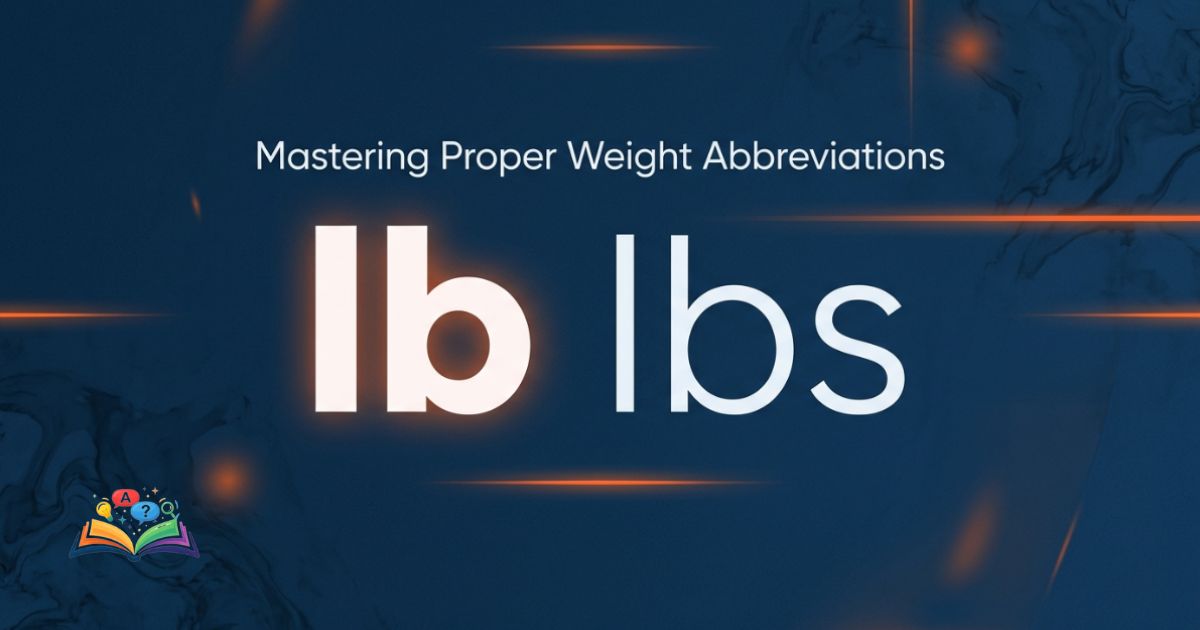
When deciding if “lb” or “lbs” is correct, both abbreviations appear widely in everyday American life, but “lb” is the technically correct term for both singular and plural pounds. This common confusion happens because people naturally want to add an “s” to make a word plural, which works for standard English words but fails for certain historical abbreviations.
In the United States, we use pounds daily for everything from grocery shopping to lifting weights at the gym. Knowing when to use lb or lbs ensures your writing looks professional and accurate. This guide explains why “lb” stands for pound, when adding an “s” is acceptable, and how to format these abbreviations properly in any context. Taking the time to master correct word usage helps you communicate clearly and avoid embarrassing grammatical mistakes.
The Latin Origins That Created The Lb Or Lbs Debate
The letters “lb” come from the Latin word “libra”, which means balance or scales. The original Roman phrase “libra pondo” translates to “a pound by weight.” Over time, the English language adopted the word “pound” from “pondo,” but kept the written abbreviation “lb” from the word “libra.”
Because “libra” is a Latin word, its plural form does not take a standard English “s.” Just like the singular versus plural debate over criteria or criterion, applying English plural rules to a Latin word causes immediate confusion. This is why “lb” technically covers both 1 pound and 100 pounds without needing an extra letter.
Grammatical Rules Determining Whether To Write Lb Or Lbs
When writing about a single pound, the rule is simple: always use “lb.” The debate starts when your measurement hits two pounds or more. In technical, academic, and scientific writing, abbreviations of measurement units do not take a plural “s.” Therefore, 10 lb is grammatically correct.
In everyday American English, people treat “lb” like a standard noun. They add an “s” to show pluralization, giving us “lbs.” While rigid style guides reject “lbs,” businesses, grocery stores, and fitness centers use it constantly. Recognizing this difference is similar to knowing if a word is officially spelled or spelt in American dictionaries. Both forms are understood, but only one is preferred for formal documentation.
| Formatting Context | Singular (1 Pound) | Plural (2+ Pounds) |
| Formal & Scientific Writing | 1 lb | 50 lb |
| Casual & Everyday Use | 1 lb | 50 lbs |
Proper Spacing Guidelines When Typing Lb Or Lbs
The standard rule for typing weight measurements requires a single space between the number and the abbreviation. You should write “5 lb” instead of “5lb.” The space makes the measurement much easier to read, especially in large documents, recipe lists, or data sheets.
There are minor exceptions in specific formatting scenarios. Sometimes, spacing gets condensed in tight data tables or on commercial product packaging where room is severely limited. However, for standard sentences, always include the space. Maintaining consistent spacing is just as important as accurately listing a quantitative or qualitative metric in a research paper.
Technical Distinctions Between Lbf And Standard Lb Or Lbs
In physics and engineering, “lb” specifically refers to pound-mass (lbm). This metric measures exactly how much physical matter is in an object. On the other hand, “lbf” stands for pound-force. This metric measures the gravitational pull acting upon that mass.
For the average person weighing a suitcase at the airport, “lb” works perfectly. Engineers must separate the two terms to avoid catastrophic math errors. If you are calculating structural loads, confusing pound-mass with pound-force will ruin your equations. This need for accuracy is similar to the strict precision required when deciding between math or maths terminology in different global regions.

How Major Academic Style Guides Treat Lb Or Lbs
Academic and journalistic style manuals are incredibly strict about weight abbreviations. The Associated Press (AP) Stylebook and the Chicago Manual of Style both dictate that you should never add an “s” to pluralize abbreviations of units. They mandate “lb” for 1 pound and “lb” for 200 pounds.
Additionally, most style guides prefer that you spell out the word “pound” or “pounds” in standard paragraphs. You should only use the abbreviation in tables, charts, or technical specifications. Following these exact rules is as critical as properly formatting a masters or master’s degree on a professional resume.
Alternative Slang Meanings Associated With Lb Or Lbs
Language evolves rapidly, and abbreviations often take on entirely new meanings online. In text messages and on social media platforms, “LBS” frequently stands for “Laughing But Serious.” People use this acronym when they make a joke that actually contains a harsh truth.
Context clues are your best friend here. If someone texts you “LBS,” they are likely not talking about the weight of their groceries. Understanding internet acronyms helps you decode modern digital conversations, much like knowing if an event happens at 12am or 12pm helps you show up on time.
Top Formatting Errors When Using Lb Or Lbs
Writing weight measurements correctly takes a little practice. Avoid these common formatting mistakes in your professional work to maintain credibility:
- Adding a period: Do not write “lb.” or “lbs.” unless the abbreviation falls at the very end of a sentence.
- Omitting the space: Always put a clear space between the number and the letters (e.g., 10 lb, not 10lb).
- Using capital letters: The abbreviation is always lowercase. Do not write “Lb” or “LB” unless it starts a sentence, which is highly discouraged anyway.
- Mixing formats: Do not switch between spelling out “pounds” and using the abbreviation within the same paragraph.
Being consistent with these rules gives your writing a clear, professional more or less meaning without confusing your reader.
Final Clarity On Writing Lb Or Lbs
When choosing between lb or lbs, default to “lb” for all formal, scientific, and academic writing, regardless of the number. It remains the grammatically correct abbreviation for both singular and plural weights. Reserve “lbs” for informal situations like grocery lists, casual texts, or personal notes.
Paying attention to these small details improves the quality of your writing. It ensures your communication is highly accurate and easy to understand, much like reviewing a credit or debit statement for financial accuracy. Stick to the standard rules, and you will never misformat a weight measurement again.

Common Questions About Lb Or Lbs
Weight measurements often cause confusion, especially when translating written abbreviations into spoken English or math. Review the frequently asked questions below for quick answers to the most common pound-related inquiries.
How Do You Verbally Say The Abbreviation Out Loud?
When reading “lb” or “lbs” in a sentence, you should always say the word “pound” or “pounds” out loud. You do not pronounce the individual letters “L” and “B” verbally.
What Does The Pound Abbreviation Mean In Internet Slang?
In texting and social media, the capitalized acronym “LBS” stands for “Laughing But Serious.” It indicates that a comment is framed as a joke but carries genuine truth.
Is One Pound Mathematically More Than A Half Pound?
Yes, one pound (1 lb) is mathematically greater than a half pound (0.5 lb or 1/2 lb). One full pound equals exactly 16 ounces, while a half pound equals exactly 8 ounces.
Should You Put A Period After Lb Or Lbs?
No, you should not put a period after the abbreviation in standard US formatting. The only exception is if “lb” or “lbs” falls at the absolute end of a sentence.
Is It Correct To Capitalize Lb As LB?
No, the abbreviation for pound should always remain in lowercase letters as “lb.” Using uppercase letters is incorrect in standard formatting unless it is being used as an internet acronym.
Slug: lb-or-lbs-correct-abbreviation