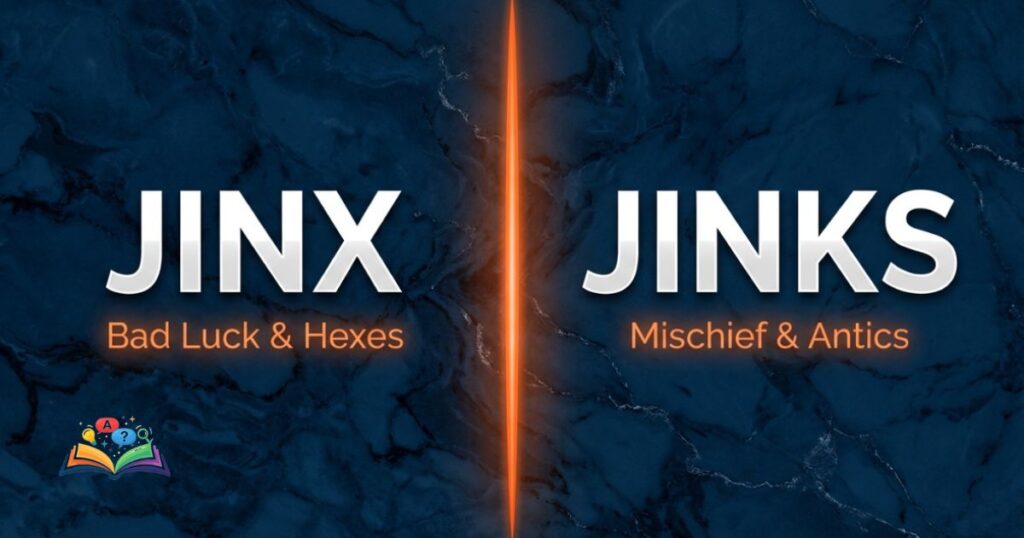
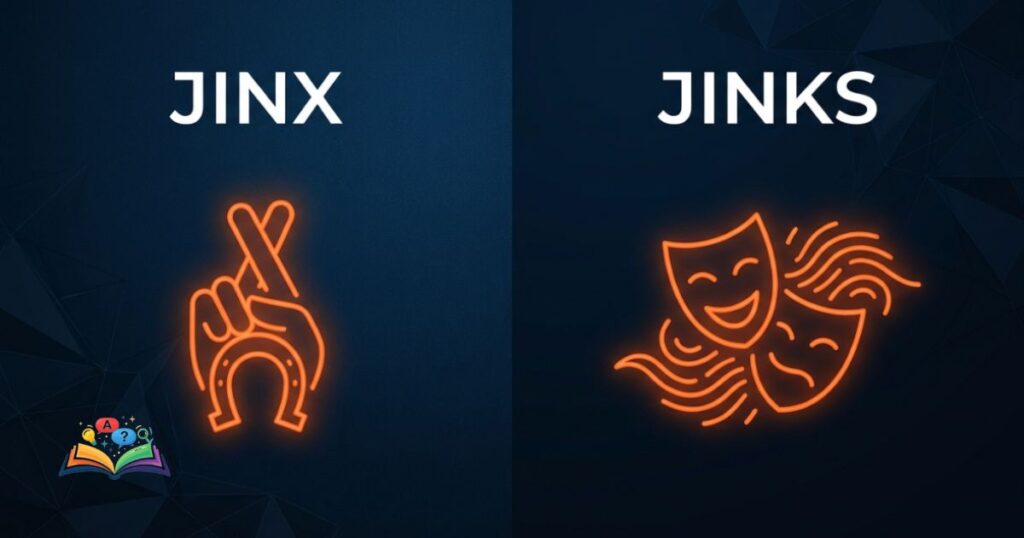
Choose Jinx when referring to bad luck, a hex, or the spoken wordplay game. Use Jinks when describing practical jokes, playful antics, or the traditional phrase “high jinks.” While these two terms sound identical, they carry distinct origins and meanings. Confusing them can easily weaken the clarity of your writing.
English is full of tricky homophones, much like choosing between stationery or stationary or figuring out site or cite. This guide covers the exact rules for using “jinx” and “jinks” correctly, including their etymological roots, popular culture references, and word game legality.
Historical Etymology: How Jinx or Jinks Entered the English Language
Tracing the origins of these two terms reveals completely separate linguistic paths. Below, you will explore how 19th-century magic shows and historical Scottish games shaped these distinct spellings.
The Folk Magic and Vaudeville Roots of Jinx
The word “jinx” entered American vernacular in the late 19th and early 20th centuries. Etymologists trace its roots to the word jynx, the Latin and Greek name for the wryneck bird. This bird was historically associated with witchcraft and fortune-telling rituals. The term gained wide popularity through American baseball culture and vaudeville theater acts, where performers used “jinx” to describe any person or object that brought sudden misfortune.
Scottish Parlor Games and the Historical Spelling of Jinks
The term “jinks” is much older, dating back to 16th-century Scotland. It stems from the Scots verb jink, which means to move quickly, dodge, or turn sharply. In the 1700s, “high jinks” emerged as a popular Scottish parlor game played at drinking gatherings, where players rolled dice and executed funny penalties or pranks. Over time, the spelling retained its “k” to reflect this historic Scottish usage.
Understanding the Wordplay Game Known as Jinx or Jinks
The wordplay game played by children and adults across the United States strictly uses the “jinx” spelling. Review the rules and variations below to understand how this game operates in casual conversation.
Standard Spoken Rules for the Jinx or Jinks Challenge
The game occurs when two people accidentally speak the exact same word simultaneously. The first person to shout “Jinx!” immediately places a ritual silence on the other person. According to traditional rules, the person who was jinxed cannot speak until someone else says their name aloud.
Person A & Person B simultaneously: “Awesome!”
Person A: “Jinx!”
Person B: [Must remain silent until named]
Variations on Paying Up When You Lose a Jinx or Jinks Round
Regional variations introduce playful stakes to the exchange. In the widely recognized American version, the person who calls out the phrase “Jinx, you owe me a Coke!” obligates the silenced participant to purchase them a soda. Other informal playground rules require the silenced player to endure a light tap on the shoulder if they break character and speak prematurely.
Idiom Rules: Why “High Jinks” Uses Jinks or Jinx Differently
The idiom “high jinks” refers to carefree, wild behavior, playful pranks, or lively antics. The traditional and dictionary-approved spelling uses the letter “k.” Writing “high jinx” with an “x” is an extremely common mistake caused by phonetic confusion.
While pop culture often relies on phonetic spellings for stylistic choices, standard English requires “high jinks.” Making this distinction keeps your writing professional, just as knowing when to use roster or roaster prevents embarrassing typos.
- Correct: The college dorm was famous for weekend high jinks.
- Incorrect: The college dorm was famous for weekend high jinx.
Pop Culture Confusion: How Media Distorts Jinx or Jinks
Media franchises frequently alter spellings for branding and character identity, making standard usage confusing for fans and writers alike.
A prominent example is the character Jinx from the video game League of Legends and the animated series Arcane. In this context, her name plays directly on the concept of bad luck, as her chaotic presence brings destruction to those around her.
Another common point of confusion comes from Pokémon, which features a creature named “Jynx” spelled with a “y.” These stylized names are creative trademarks and should not replace standard dictionary spellings in everyday writing.
Slang and Social Context: Is Jinx or Jinks Offensive or Rude?
Neither “jinx” nor “jinks” is considered offensive, rude, or profane in modern English. Both words are entirely acceptable for general conversation, professional contexts, creative writing, and academic work.
Calling someone a “jinx” can carry a slightly negative connotation if said with real frustration, as it implies that the person brings bad luck. However, in almost all social situations, the term is used lightheartedly. Saying “don’t jinx it” is a harmless superstitious idiom used when someone voices an optimistic prediction too early.
Scrabble and Word Game Rules for Jinx or Jinks Variations
Both “jinx” and “jinks” are legal, valid words in official Scrabble gameplay, though they offer different strategic benefits on the board.
| Word | Tile Count | Base Score | Valid Plural / Conjugations |
| JINX | 4 Letters | 18 Points | JINXES, JINXED, JINXING |
| JINKS | 5 Letters | 16 Points | JINK (Base verb) |
| JYNX | 4 Letters | 17 Points | JYNXES |
“Jinx” yields a higher base point total in Scrabble due to the high value of the letter “X” (8 points). “Jinks” is also playable because “jink” functions as a valid verb meaning to dodge or weave. Additionally, the alternative spelling “jynx” is recognized in official Scrabble dictionaries.
Grammar and Pronunciation Rules for Jinx or Jinks Usage
Despite their different spellings and historical meanings, “jinx” and “jinks” are pronounced identically in standard American English. Both words use the single-syllable phonetic structure /dʒɪŋks/.
When applying grammar rules, treat “jinx” as a regular verb that accepts standard endings:
- Base Form: Jinx
- Third-Person Singular: Jinxes
- Past Tense: Jinxed
- Present Participle: Jinxing
Avoid treating “jinks” as a standard verb in modern writing unless you are specifically describing rugby players dodging tackles. Stick strictly to its plural noun form within the phrase “high jinks.” Understanding these subtle grammatical differences ensures your sentence structures remain sound, much like mastering parenthesis or parentheses or correctly identifying unkept or unkempt.
Final Clarity on Applying Jinx or Jinks in Your Writing
To maintain complete clarity across all your writing projects, keep this quick summary in mind:
- Use Jinx (with an “x”) whenever you refer to bad luck, superstitious curses, or the informal word-matching game.
- Use Jinks (with a “k”) when writing about antics, pranks, or the traditional idiom “high jinks.”
- Do not interchange these spellings in formal essays or professional correspondence.
If you enjoy mastering English spelling nuances, explore our detailed guides on commonly confused words, including tricky pairs like griefing or grieving and waisted or wasted.
Common Questions About Choosing Between Jinx or Jinks
Can You Use Jinx or Jinks Interchangeably in Formal English?
No, you cannot use “jinx” and “jinks” interchangeably in formal writing. “Jinx” refers specifically to bad luck or hexes, while “jinks” is restricted to playful antics within the phrase “high jinks.” Substituting one for the other creates a spelling error.
Is it “Hi Jinx” or “High Jinks” When Referring to Mischief?
The correct spelling is “high jinks.” Writing “hi jinx” or “high jinx” is a common error stemming from modern phonetic spelling. Traditional English style guides require “high jinks” with both a “gh” and a “k.”
What Does “Don’t Jinx It” Mean Compared to Jinks?
“Don’t jinx it” means expressing caution so that someone does not bring bad luck to an ongoing situation by boasting or making optimistic predictions too soon. It has no linguistic connection to “jinks,” which describes mischievous behavior.
Are Alternative Spellings Like Jynx Valid Alongside Jinx or Jinks?
“Jynx” is a valid alternative spelling in specialized contexts, such as the official Scrabble dictionary or scientific Latin names for the wryneck bird genus. However, in standard written English, “jinx” remains the only accepted spelling for bad luck.
Is Jinks a Real Word on Its Own?
Yes, “jinks” is a real word. It serves as the plural noun form in “high jinks” and acts as the third-person singular form of the verb “jink,” which means to make a quick, darting movement to avoid something.