
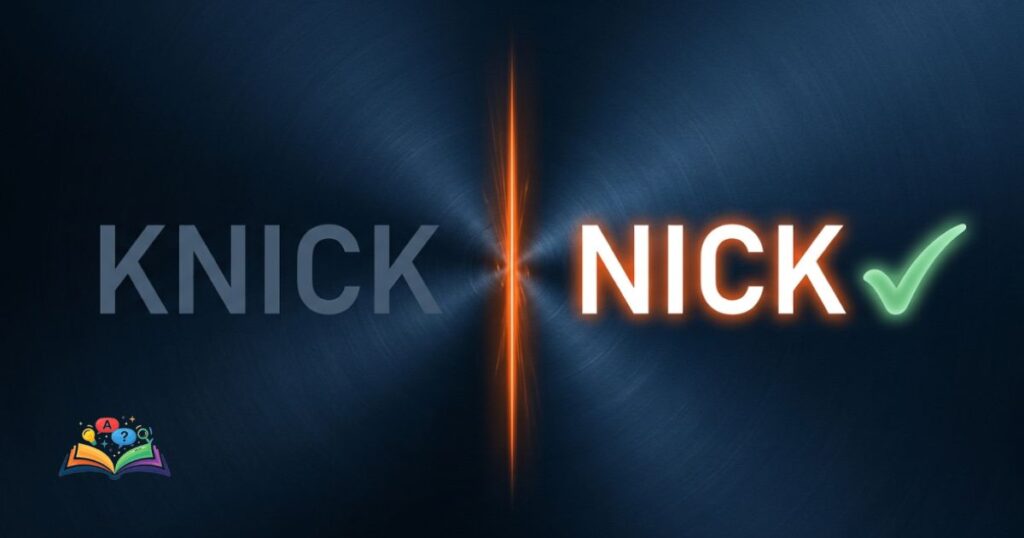
If you are unsure whether to write knick or nick, you are dealing with one of the most frequent spelling traps in the English language. The short answer is that nick (without a “k” at the start) is the correct word in almost every everyday scenario, including minor cuts, small surface scratches, stealing something, or hitting a deadline in the “nick of time.”
The spelling knick (with a silent “k”) is rarely a standalone word in modern American English. Instead, it almost exclusively appears as part of compound terms like “knick-knack” or historical names such as “Knickerbocker.”
Understanding when to drop the silent “k” will instantly clean up your writing. This guide breaks down the origins, definitions, sentence examples, and idiomatic uses of both words so you never confuse them again.
Why People Regularly Mix Up Knick or Nick in English
The confusion between these two words comes down to phonetics and silent letters. In English, the consonant pair “kn” traditionally produces a simple “n” sound, as seen in words like knee, knife, or know. Because the initial “k” is completely silent, “knick” and “nick” sound identical when spoken aloud.
Another reason for the mix-up is visual association. People are familiar with terms like “knick-knack” or basketball teams like the New York Knicks. As a result, the brain wrongly assumes that “knick” must be a valid standalone spelling for small notches or cuts.
The Definitive Spelling Rules for Knick or Nick Usage
To keep your writing clean, remember a simple rule: if you are using the word as a standalone noun or verb, you almost certainly need nick.
- Use “Nick” when referring to:
- A small notch, groove, or cut on a surface.
- A minor wound on your skin (such as a shaving cut).
- The precise critical moment (in the nick of time).
- Informal actions, like making a small mark or notch.
- Use “Knick” only when:
- Writing the compound noun “knick-knack.”
- Referencing specific proper nouns, like the New York Knicks.
Mixing up silent letters is a common issue in English orthography, similar to deciding between stationary or stationery when buying paper supplies.
Resolving Knick or Nick of Time Idiom Misconceptions
The phrase meaning “just at the critical moment” or “barely in time” frequently suffers from spelling mistakes. If you want to know how the idiom started and why adding a “k” breaks standard rules, explore the details below.
Origins of the Phrase “In the Nick of Time”
The expression dates back to the 16th century. In accounting and timekeeping, people kept track of scores, tallies, or passing hours by carving small notches—called “nicks”—into wooden tally sticks. Hitting the exact mark meant reaching the exact “nick” cut into the wood. Over time, hitting the exact notch became a metaphor for arriving at the precise required moment.
Why Writing “Knick of Time” Is Always Considered an Error
Because the idiom stems directly from carving a small mark (“nick”) into wood, inserting a silent “k” destroys the historical origin of the phrase. Writing “knick of time” is a modern misspelling driven purely by phonetic confusion. Standard dictionary guidelines and style manuals view “knick of time” as flatly incorrect.
How to Correctly Use Knick or Nick for Shaving Cuts and Minor Wounds
When you accidentally slice your skin with a razor while shaving, you have sustained a nick, not a knick. In medical and personal grooming contexts, a nick refers to a very shallow, minor laceration that barely bleeds.
- Correct: I got a small nick on my chin while shaving this morning.
- Incorrect: Be careful with that new razor so you do not knick your ankles.
Confusing similar-sounding words happens often in daily health and wellness routines, much like deciding whether you are sweat or sweet after a hard workout.
Understanding Knick or Nick for Woodwork, Furniture, and Material Damage
In carpentry, construction, and interior design, small physical defects on materials are regularly discussed. The proper term for a tiny gouge, dent, or scratch on a wooden table, metallic surface, or piece of glass is a nick.
Correct Example: The movers left a slight nick on the edge of the dining table.
Incorrect Example: We need to fill that knick in the cabinet door with wood putty.
If you are restoring old furniture, keeping track of minor surface damage is key. It is just as frustrating as trying to fix a finish when you feel wasted or waisted effort on the wrong materials.
Deciphering British Slang: Choosing Knick or Nick When You Mean Steal
While American English focuses heavily on physical cuts or timing, British slang uses nick in several distinct ways. Understanding these informal definitions prevents confusion when reading international literature or watching imported television shows.
- Stealing: To “nick” something means to steal or swipe it (e.g., Someone nicked my bicycle.).
- Arrest or Prison: Being “nicked” means getting arrested by the police, and “the nick” refers to prison.
- Physical Condition: The phrase “in good nick” means something is in excellent physical health or prime working condition.
In all these informal British usages, the spelling remains nick. Writing “knick” in any of these slang contexts is incorrect.
Exploring Knick-Knack and Other Rare Words in the Knick or Nick Debate
The letter “k” is not entirely useless here; it simply belongs to a very narrow group of specific compound terms. The most common word featuring this spelling is knick-knack (sometimes spelled knickknack), which refers to a small, decorative ornament or trinket kept on a shelf.
Historically, “knick” derived from an old Germanic root related to snapping or clicking sounds. Over time, it survived almost exclusively in reduplicative phrases where two similar sounds are paired together, such as “knick-knack.” Another prominent example is the term “Knickerbocker,” which originally described Dutch settlers in New York and eventually inspired the name of the NBA’s New York Knicks.
Navigating tricky language history is a common hurdle, similar to learning when to use parenthesis or parentheses in formal grammar.
Quick Reference Chart to Resolve Any Knick or Nick Uncertainty
When writing quickly, consult this handy reference table to pick the correct word instantly:
| Usage Context | Correct Spelling | Sentence Example |
| Shaving Cut / Skin Scratch | Nick | He put a tiny piece of tissue on his shaving nick. |
| Furniture / Surface Damage | Nick | There is a small nick on the side of the desk. |
| Idiom (Critical Moment) | Nick of time | She finished the exam in the nick of time. |
| Trinket / Small Decoration | Knick-knack | Dust gathered on the ceramic knick-knacks. |
| Slang for Stealing | Nick | Watch your phone so nobody tries to nick it. |
Just as you might double-check bolder or boulder when describing a heavy rock, reviewing a quick comparison table helps prevent simple typos.

Final Clarity on Choosing Between Knick or Nick Every Time
Mastering this pair comes down to a single mental shortcut: treat nick as your absolute default word. Whether you are talking about shaving cuts, damaged furniture, British slang, or arriving right on time, “nick” is the only spelling you need.
Reserve knick strictly for trinkets (“knick-knacks”) or proper nouns like the New York Knicks. By keeping this rule in mind, you will eliminate spelling errors and maintain complete confidence in your writing.
Understanding word patterns makes language much easier to navigate. To continue sharpening your vocabulary, explore our complete list of commonly confused words or check out similar spelling guides like peel or peal to polish your skills.
Common Questions About Knick or Nick Usage
Is a Minor Cut Spelled Nick or Knick?
A minor cut is always spelled nick. Writing “knick” for a cut on your skin or a shaving injury is a spelling error.
How Do You Spell Nick When It Means Stealing?
When using informal slang that means to steal or snatch something, the correct spelling is nick (e.g., “He tried to nick my wallet”).
What Is the Meaning of a Knick-Knack?
A knick-knack is a small, decorative object, ornament, or trinket that usually has little financial value but is kept for display.
Is It “In Good Nick” or “In Good Knick”?
The correct British slang expression is “in good nick,” which means that an object or person is in great physical condition.
Why Do People Add a K to Nick in Everyday Writing?
People often add a “k” because they confuse the word with “knick-knack” or are misled by other English words starting with a silent “kn,” such as knee or know.