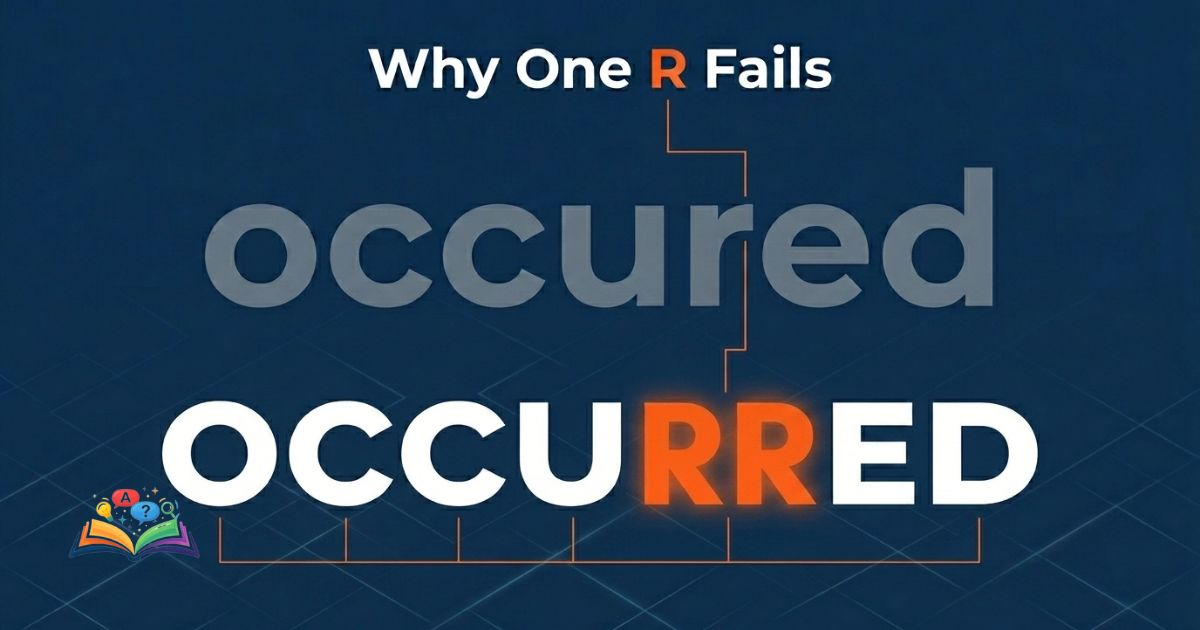
If you’ve ever paused while writing “occurred” or “occured,” you’re not alone. This is a very common spelling confusion because the two versions look similar, but only one follows the correct English spelling rule.
The correct spelling is “occurred,” with a double r. The version “occured” is incorrect because it breaks the standard rule for verbs that double the final consonant before adding -ed. Once you understand that rule, this spelling mistake becomes much easier to avoid.
Is “Occurred” or “Occured” the Correct Spelling?
“Occurred” is the correct spelling. “Occured” is incorrect because the base verb “occur” doubles the final “r” before adding “-ed.” This follows the standard English consonant-doubling rule, which is why “occurred” is the only accepted spelling in English.
Many people search for “occurred or occured which is correct” because both spellings seem reasonable at first glance. However, dictionaries and grammar rules recognize only “occurred.”
For example:
- Correct: The accident occurred last night.
- Incorrect: The accident occured last night.
Using the correct spelling improves clarity and helps avoid a common writing mistake.
Why “Occurred” Is the Accepted Standard Spelling
The word “occurred” comes from the verb “occur.” When changing it into the past tense, English spelling rules require the final r to double before adding -ed.
This is why:
- occur → occurred
- refer → referred
- prefer → preferred
This pattern is part of normal English spelling behavior.
Why “Occured” Is a Common but Incorrect Misspelling
The spelling “occured” often appears because writers forget to double the final consonant. Since the base word “occur” already ends in r, many assume adding -ed is enough.
But English does not work that way here. Just like people confuse opening or openning, doubling consonants often creates uncertainty.
Why “Occured” Looks Correct Even Though It Is Wrong
At a glance, “occured” appears logical because many verbs simply add -ed in the past tense. That visual similarity is what causes the confusion.
However, “occur” belongs to a group of verbs that follow the consonant-doubling rule. That is why “occured” looks right but is still a misspelling.
How Double Consonants Create Confusion in “Occurred”
Words with double consonants often confuse writers because English spelling patterns are inconsistent. Compare:
- occur → occurred
- visit → visited
In one case, the consonant doubles; in the other, it does not. This inconsistency leads to errors.
This is the same kind of confusion found in words like label or lable, where spelling expectations can be misleading.
Why Writers Often Drop One “R” in “Occurred”
Writers often simplify spellings mentally, especially when typing quickly. Since “occur” already contains two c’s, it feels visually “complete,” making it easy to overlook the need for another r.
That shortcut leads to “occured,” even though the correct spelling is “occurred.”
The Spelling Rule That Explains Why “Occurred” Has Double “R”
The reason “occurred” has two r’s is that “occur” ends in a stressed vowel + consonant pattern. Under English spelling rules, that final consonant doubles before adding -ed.
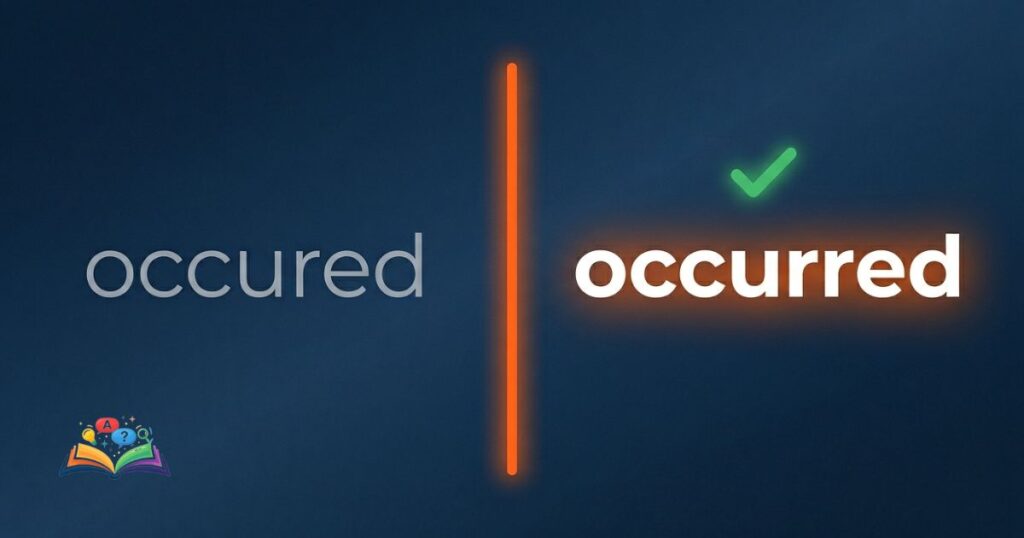
Understanding this rule helps with many similar verbs.
How “Occur” Changes When “-ed” Is Added
The verb “occur” changes like this:
occur + red = occurred
The final r doubles because the last syllable is stressed:
oc-CUR
That stress triggers the consonant doubling.
Why the Final Consonant Doubles in “Occurred”
When a verb ends in:
- one vowel
- one consonant
- a stressed final syllable
…the final consonant doubles before -ed.
That is why:
- occur → occurred
- admit → admitted
- permit → permitted
This same spelling logic helps explain errors like prove or proove, where people incorrectly apply spelling patterns.
Correct Sentence Examples of “Occurred” in Everyday Writing
Seeing “occurred” used correctly in real sentences makes the spelling easier to remember.
It also helps reinforce how the past tense form should look in everyday writing.
Examples of “Occurred” Used in Past Events
Here are some correct examples:
- The meeting occurred on Monday.
- A problem occurred during the test.
- The delay occurred because of bad weather.
Each sentence uses the correct past tense spelling.
Examples Showing Why “Occured” Should Never Be Used
These are incorrect:
- The meeting occured on Monday.
- An error occured yesterday.
The missing r makes the spelling invalid.
Writers who struggle with this may also confuse similar forms such as wisk or whisk.
An Easy Memory Trick to Spell “Occurred” Correctly
A quick memory trick can help prevent the “occured” mistake.
Remember that “occurred” keeps the double sound pattern by using double c + double r.
How to Remember the Double “R” in “Occurred”
Think of it like this:
OccuRRed needs two R’s because the action really happened.
That phrase reinforces the double r.
A Simple Visual Pattern to Avoid Writing “Occured”
Break the word into parts:
oc + cur + red
This makes the double r easier to see.
Visual chunking helps reduce common spelling mistakes, just as it does with bearable or bareable.

The Correct Way to Spell “Occurred” Without Second Guessing
The easiest way to avoid mistakes is to remember that “occurred” always keeps the doubled r in the past tense.
Once you recognize the spelling rule, the correct version becomes easier to spot instantly.
What to Double-Check Before Writing “Occurred”
Before writing the word, ask:
- Does the base verb end in a stressed consonant?
- Does the final consonant need doubling?
For “occur,” the answer is yes.
How Learning the Rule Prevents This Mistake for Good
Memorizing the rule is far better than memorizing the word alone.
When you understand why “occurred” is correct, you can apply the same rule to other verbs and avoid repeating the same spelling confusion.
That broader understanding helps with many common spelling questions, especially in grammar comparison topics linked from your which word is correct guide.
Common Questions About “Occurred” and “Occured” Answered
Many writers still have questions about whether “occured” is accepted in any form or why spelling tools mark it wrong.
These quick answers clear up the confusion.
Is “Occured” Ever Accepted in UK English?
No. “Occured” is incorrect in both American and British English.
Whether you write for US or UK audiences, “occurred” is the correct spelling.
Why Spell Check Flags “Occured” as Incorrect
Spell check flags “occured” because it does not match the accepted dictionary spelling.The correct form is “occurred,” following the consonant-doubling rule.