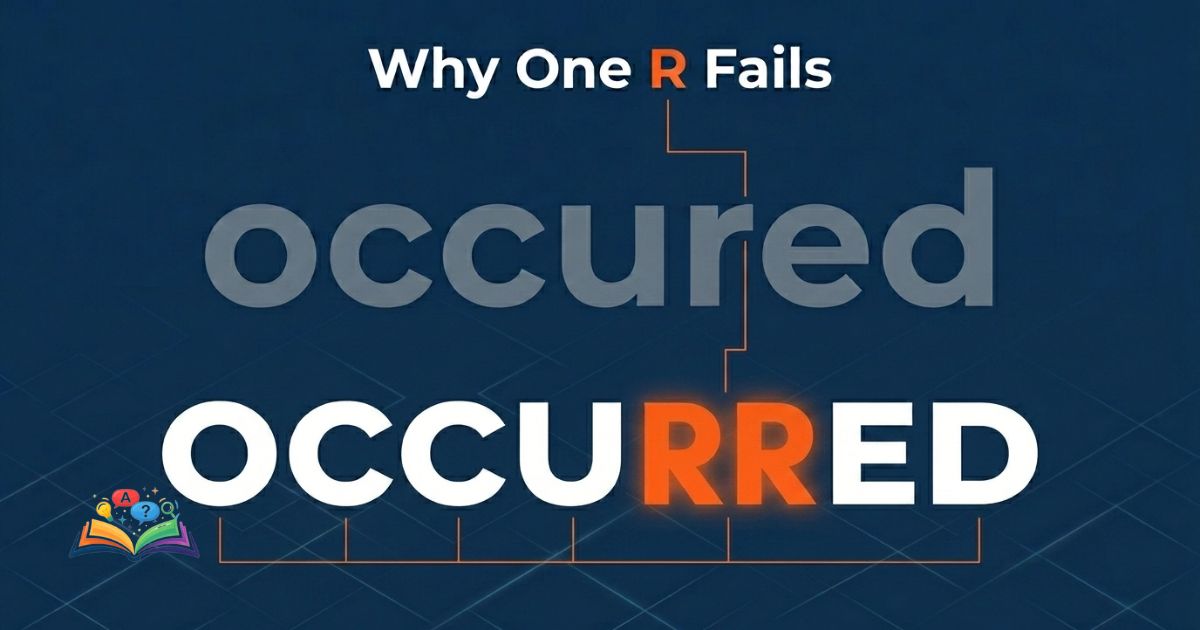
If you have ever stopped typing to ask yourself whether you should use a single or double “r” in the past tense of “occur,” you are definitely not alone. This is one of the most common spelling dilemmas in the English language because both versions look visually correct at first glance.
However, only one spelling follows the standard English spelling rules. Using the incorrect version can make your writing look unpolished, whether you are drafting a business email, an academic paper, or a blog post. This guide will clarify the correct spelling, explain the grammatical rule behind it, and provide simple memory tricks to ensure you always get it right.
Is It Occurred or Occured? The Correct Spelling Revealed
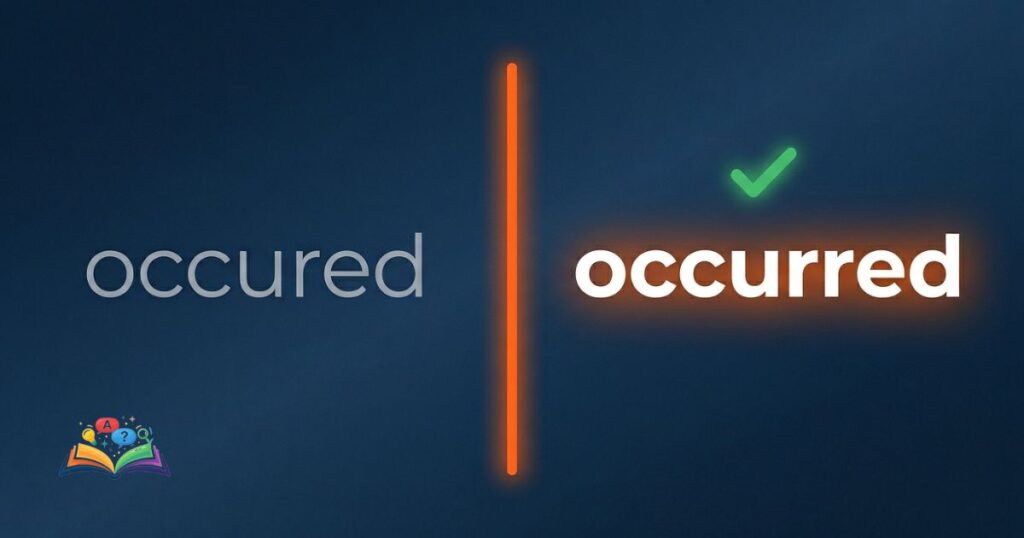
The only correct spelling in modern English is occurred (with a double “r”). The alternative spelling, occured, is entirely incorrect and is classified as a spelling mistake by all major dictionaries.
| Correct Spelling | Incorrect Spelling | Base Word |
| Occurred ✅ | Occured ❌ | Occur |
Much like the widespread hesitation writers face when deciding between definately or definitely, this error is incredibly frequent. However, remember that “occurred” must always retain two “c”s and two “r”s.
Why People Confuse Occurred or Occured in Everyday Writing
The root of this confusion lies in how English verbs typically change into the past tense. For most verbs, you simply add “-ed” to the end of the base word (e.g., jump becomes jumped). Because the base word is “occur,” many writers assume they just need to attach the suffix, resulting in “occured.”
Writers often simplify spellings mentally when typing quickly, either dropping letters or adding them where they do not belong. We see this same exact type of structural confusion when people debate the proper spelling of develop or develope. Because “occured” visually looks like a complete word, the mistake easily slips past proofreaders.
The Grammar Rule That Settles the Occurred or Occured Debate
There is a specific grammatical rule that dictates why the final consonant doubles here. When a verb ends in a consonant-vowel-consonant (CVC) pattern, and the stress falls on the final syllable, you must double the final consonant before adding a suffix that begins with a vowel (like -ed or -ing).
- Step 1: The word is oc-CUR.
- Step 2: The stress is heavily on the final syllable.
- Step 3: Therefore, the “r” doubles to become occurred.
This exact same rule applies to other verbs. For instance, this is why we see the same consonant doubling in the past tense of refer (referred) and when deciding between transferred or transfered.
How Double Consonants Complicate Occurred or Occured
Words containing double consonants are notorious for tripping up even the most experienced writers. Because English spelling patterns are famously inconsistent, people tend to overcompensate or undercompensate with double letters.
Think about the confusion surrounding prove or proove. Writers know a double letter belongs somewhere, but they struggle to place it. With “occurred,” the word already has double “c”s, which tricks the brain into thinking the word has enough double letters, leading people to incorrectly drop the second “r.”
Correct Sentence Examples for Occurred or Occured
Seeing the correct spelling applied in real-life context is one of the best ways to train your brain to recognize it naturally. Notice how the base verb changes in the past tense without losing its double consonant structure.
- ✅ The power outage occurred right in the middle of the storm.
- ✅ We are still trying to figure out how the error occurred.
- ❌ The meeting occured on Monday morning. (Incorrect)
Conversely, words where the stress is on the first syllable do not double the consonant. This is a common pitfall seen in the opening or openning debate. Because the stress is on the “O” in open, the “n” does not double.
Memory Tricks to Choose Between Occurred or Occured
If you find yourself constantly relying on spell check, a simple mnemonic device can help you eliminate this mistake permanently. Visual chunking is a fantastic way to remember complex spellings, just as it helps when deciphering bearable or bareable.
The “Two Events” Trick: Think to yourself: “Two things happened, so I need two C’s and two R’s.”
- o-CC-u-RR-ed
By separating the word into visual blocks (oc + cur + red), the double “r” becomes much easier to see and remember.
Regional Differences: British vs. American English for Occurred or Occured
Many spelling inconsistencies in English are due to regional differences. For instance, Americans write “color” while the British write “colour.” So, does geography dictate how we spell this past-tense verb?
No. Just like the universal rules applying to words such as label or lable, there is absolutely no regional variation here. Whether you are writing for an audience in the United States, the United Kingdom, Canada, or Australia, occurred is the only accepted spelling.
Why Spell Check Flags the Wrong Spelling of Occurred or Occured
If you type “occured” into Microsoft Word, Google Docs, or Grammarly, you will immediately see a red squiggly line. Spell checkers flag this because it violates standard dictionary entries.
Fast typing often leads to missed keystrokes, similar to the common kitchen typo of wisk or whisk. However, relying entirely on auto-correct can build bad habits. By understanding the actual grammar rule behind the red line, you can become a more confident, independent writer.

Final Thoughts on the Occurred or Occured Spelling Dilemma
To summarize, the debate is easily settled by understanding English suffix rules. Occurred is always spelled with two “c”s and two “r”s because the stress falls on the final syllable of the base word. The spelling “occured” is always a mistake.
By remembering the simple rule of doubling the consonant, you will ensure your writing remains professional, clear, and free of distracting errors.
Frequently Asked Questions
Is “occured” ever accepted in UK English? No. The spelling “occured” is completely incorrect in both British and American English. The only correct spelling globally is “occurred.”
Why is there a double “R” in occurred? The double “R” exists because the base word “occur” ends in a consonant-vowel-consonant pattern, and the vocal stress lands on the final syllable (oc-CUR). English grammar dictates that you must double the final consonant before adding an “-ed.”
What is the correct spelling: occurred or occured? The correct spelling is “occurred.”
Does “occurring” also have two R’s? Yes. Following the exact same grammatical rule, the present participle is spelled “occurring” with a double “R.”
Is it occur or occure? The correct base verb is spelled “occur” without an “e” at the end.