
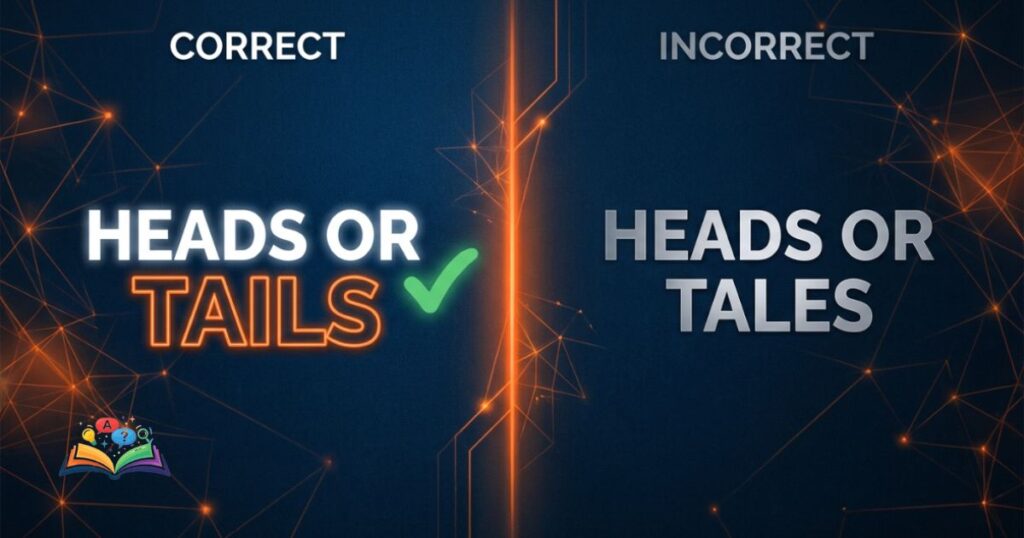
If you have ever stopped mid-sentence while typing out a simple decision-making phrase, you know how tricky simple English idioms can be. The correct phrasing for a coin toss decision is “heads or tails.” While it sounds simple, writers frequently pause to check whether “tails” ends with an “s” or if it should be spelled like a storybook “tales.”
This confusion is completely normal. Words that sound identical often trip people up, leading to common word confusions in everyday writing. The issue comes down to homophones, historical coinage habits, and basic English grammar rules.
This guide breaks down why “heads or tails” is the only correct spelling, why “tales” is always a misspelling in this context, and how to avoid simple typos when writing about a coin flip.
Why the Heads or Tails Spelling Often Causes “Tails vs. Tales” Confusion
The mix-up between “tails” and “tales” happens because human brains prioritize sound over spelling when writing quickly. To master the correct spelling, you need to understand how phonetic overlap creates written errors.
Below, we examine why our minds jump to story-based words and how sound-alike words disrupt proper grammar choices.
Why Do People Mistake “Tails” for Story-Based “Tales”?
People confuse these terms because “tail” and “tale” sound identical in speech. A “tale” is a narrative or story, like a fairy tale. A “tail” is the rear extremity of an animal or, by extension, the back side of a coin.
Because both words are common vocabulary, writers sometimes pick the wrong spelling on autopilot. It is a similar trap to choosing between site or cite when referencing a location versus a source. Remembering that a coin has a physical “tail” helps lock in the “ai” spelling.
How Homophones Distort the Proper Heads or Tails Spelling
Homophones are words that share the same pronunciation but have different spellings and meanings. English contains hundreds of them, from peel or peal to “tails” and “tales.”
When you say “heads or tails” out loud, the listener hears the sound /teɪlz/. Without visual context, the brain does not automatically attach a specific spelling to that sound. When converting speech to text, writers who rely on sound alone often select “tales” by mistake.
The Linguistic Origin and History Behind the Heads or Tails Spelling
Understanding where a phrase comes from makes its spelling much easier to remember. The tradition of naming the two sides of a coin dates back thousands of years to ancient civilizations.
Exploring historical coinage helps explain why we use these exact terms today. Read on to see how ancient coins shaped our modern vocabulary.
Why Are They Called “Heads” and “Tails” on a Coin?
The side called “heads” usually features the profile head of a monarch, president, or historical figure. In the United States, quarters feature George Washington, while pennies feature Abraham Lincoln.
The opposite side became known as “tails” as a natural contrast to the head. Just as an animal has a head at the front and a tail at the back, a coin has a “head” on the front and a “tail” on the reverse.
Historical Coinage Terms That Shaped the Heads or Tails Spelling
Before “heads or tails” became the standard English phrase, other cultures used different terms based on their coin designs.
- Ancient Rome: Romans called the game capita aut navia (“heads or ships”) because coins featured the emperor’s head on one side and a ship’s prow on the other.
- Old England: In 17th-century England, people played a similar game called “cross and pile.” One side had a cross, and the other (the pile) was the side struck by the die.
- Modern Usage: By the 1680s, English writers began recording the phrase “cross or pile,” which eventually evolved into the anatomical comparison “heads or tails.”
Grammatical Rules Governing the Heads or Tails Spelling and Plural Form
Beyond spelling, the phrase follows specific rules regarding pluralization. Writers often ask why both words end in “s” even when flipping a single coin.
Applying proper grammar ensures your writing remains polished and accurate. The following sub-sections address pluralization and single-form exceptions.
Why Is the Heads or Tails Spelling Plural Instead of Singular?
The phrase uses plural forms (“heads” and “tails”) as a traditional idiom. When you flip a coin, you call out one of the potential outcomes as a category.
Even though a single coin has only one head and one tail, the fixed expression in English requires the plural ending. Misusing plurals in fixed idioms is as jarring as messing up parenthesis or parentheses in technical writing.
Is Saying “Head or Tail” Ever Correct in English Grammar?
Saying “head or tail” in the singular is almost always grammatically incorrect when referring to a coin toss.
- Incorrect: Flip the quarter and call head or tail.
- Correct: Flip the quarter and call heads or tails.
The only time you might see singular forms is when “head” or “tail” acts as an adjective describing a specific side: “The coin landed head side up.” However, when naming the game or the call itself, always use the plural form.
Common Typographic Mistakes to Avoid in Heads or Tails Spelling
Typographical errors frequently slip past digital spell-checkers. Because “tales” is a real word, automated software like Microsoft Word or Google Docs will not flag “heads or tales” as a spelling mistake.
Watch out for these common typing traps:
- The Homophone Slip: Typing “tales” instead of “tails.”
- The Singular Drop: Forgetting the “s” and writing “head or tail.”
- The Hyphen Omission: Forgetting to hyphenate the phrase when using it as a compound modifier before a noun (e.g., “a heads-or-tails toss”).
Just as double-checking cancelation or cancellation prevents editing errors, reviewing your coin toss references keeps your prose clean.
How the Heads or Tails Spelling Translates Across Other Languages
Different cultures use distinct visual metaphors for coin tossing. While English speakers use anatomical terms (“heads” and “tails”), other languages reference religion, symbols, or coin artwork.
- Spanish: Cara o cruz (“Face or cross”)
- French: Pile ou face (“Pile or face”)
- German: Kopf oder Zahl (“Head or number”)
- Italian: Testa o croce (“Head or cross”)
When translating foreign texts into English, always use “heads or tails” to preserve the natural idiomatic meaning for American readers.
Pop Culture and Media References Affecting Heads or Tails Spelling
The phrase appears regularly across movies, literature, and American sports. In the NFL, every game begins with an official referee leading a coin toss to determine who receives the ball first.
In literature and film, character decisions often hinge on a coin flip. For example, Batman’s villain Two-Face relies on a scratched coin to make life-or-death choices. Proper news coverage and sports journalism require accurate spelling of “heads or tails” to maintain professional editorial standards.
Slang and Figurative Sentences Using the Heads or Tails Spelling
The phrase extends far beyond literal coin flips. In everyday English, “heads or tails” appears frequently in idiomatic expressions meaning to understand or make sense of something.
The most common slang structure is “can’t make heads or tails of [something].” This means you are completely confused by a situation, similar to feeling overwhelmed when sorting out undescribable or indescribable details.
Here are sample sentences showing correct usage:
- “I have been staring at these tax forms for an hour, and I can’t make heads or tails of them.”
- “Before the kickoff, the team captains gathered at midfield for the heads-or-tails call.”
- “It does not matter which path we take; it is a total heads or tails decision.”
Final Clarity on Heads or Tails Spelling and Proper Usage
To keep your writing accurate, remember that the back of a coin is a physical tail, not a storybook tale. Always retain the plural “s” on both words, keeping the phrase as “heads or tails.”
Whether you are describing an NFL game, writing a fiction story, or using the phrase as an idiom for confusion, sticking to “tails” ensures your grammar stays flawless.
Common Questions About Heads or Tails Spelling and Phrasing
What Is the Only Correct Way to Spell “Heads or Tails”?
The only correct spelling is “heads or tails.” You must spell “tails” with “ai” and include the plural “s” on both words.
Why Do We Say “Heads or Tails” Instead of “Front or Back”?
English speakers use “heads or tails” because early coins featured an anatomical head on the front side, making “tail” a natural contrast for the reverse side.
Can You Ever Use “Tales” When Referring to a Coin Flip?
No. “Tales” refers exclusively to stories or narratives. Using “tales” for a coin toss is always a spelling error.
What Is the Plural Form When Flipping Multiple Coins?
Even when flipping multiple coins, the phrase remains “heads or tails.” For example: “We flipped five quarters and counted the heads and tails.”
Is “Heads or Tails” Hyphenated?
It is only hyphenated when used as a compound adjective before a noun, such as “a heads-or-tails decision.” In general sentence use, do not use hyphens.