If you have typed “cancelation” and wondered if it looked wrong, you are not imagining things. The spelling confuses many English speakers because both versions appear online, in dictionaries, and even in published writing.
In modern US English, “cancellation” with a double “l” is the standard spelling. “Cancelation” exists, but it is far less common and is usually treated as a variant spelling. The confusion gets even bigger when people compare American and British English spellings like “canceled” and “cancelled.”
This guide explains why “cancellation” became dominant, how spelling rules changed over time, and when each version appears in real writing. You will also see grammar patterns, sentence examples, and common spelling mistakes that cause confusion.
Why “Cancellation” Is More Common Than “Cancelation”
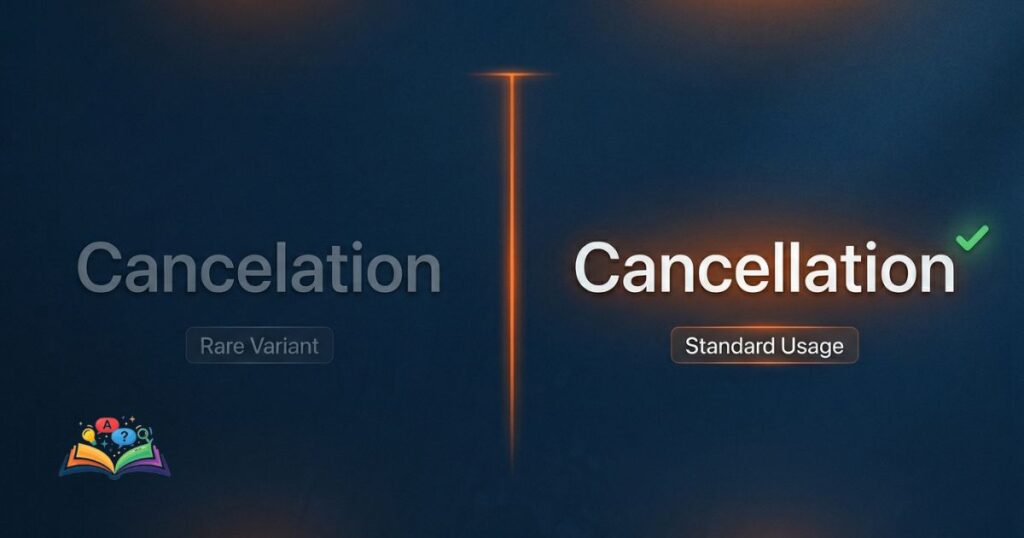
“Cancellation” is the standard and most widely accepted spelling in US English. Although “cancelation” appears in some dictionaries as a variant, it is much less common in books, newspapers, business writing, and academic content. Most style guides, editors, and spell-check tools prefer “cancellation” with a double “l.”
For example:
- Correct: The flight cancellation delayed hundreds of passengers.
- Less Common Variant: The flight cancelation delayed hundreds of passengers.
This spelling confusion is similar to other commonly mixed-up English words covered in this guide to commonly confused English words.
Why People Confuse Cancellations And Cancelation
The confusion exists because English spelling rules are not always consistent. Some words keep a doubled consonant when suffixes are added, while others drop one letter depending on the style guide or country.
The sections below explain how these spelling patterns developed and why American and British English handle “cancel” differently.
How Double-L And Single-L Spellings Developed In English
The verb “cancel” originally came from Latin through French. Over time, English adopted multiple spelling patterns for words ending in “l.”
British English usually doubles the “l” before adding endings:
- cancelled
- cancelling
- traveller
American English often simplifies the spelling:
- canceled
- canceling
- traveler
However, “cancellation” stayed with the double “l” in both major English styles. That is why many people expect “cancelation” to be correct, even though it is rarely used.
You can see similar spelling confusion in words like bingeing or binging and extravert or extrovert.
Why American And British English Treat “Cancel” Differently
American English favors shorter spellings in many cases. Noah Webster pushed for simplified spelling patterns in American dictionaries during the 1800s.
That is why Americans commonly write:
- canceled
- canceling
British English usually keeps the doubled consonant:
- cancelled
- cancelling
Still, “cancellation” remained widely accepted with two “l” letters even in the US. That makes this word different from verbs like “canceled.”
The same kind of regional spelling split appears in confusing word pairs such as stationary or stationery and site or cite.
Why “Cancellation” Uses A Double L But “Canceled” Often Does Not
English spelling changes depending on the suffix added to the base word. That is why “canceled” and “cancellation” follow different patterns even in American English.
The sections below break down the grammar behind these spelling shifts.
The Grammar Pattern Behind Adding Suffixes To “Cancel”
When “-ation” gets added to “cancel,” the word changes form significantly. English traditionally keeps the double “l” in this construction:
- cancel + ation = cancellation
That pattern became standardized through publishing, dictionaries, and formal writing conventions.
Meanwhile, adding “-ed” creates more flexibility:
- canceled
- cancelled
In American English, the shorter form became dominant.
This spelling behavior is similar to tricky word forms like parenthesis or parentheses and role or roll.
Why Spelling Rules Change Between “-ed” And “-ation”
Suffixes affect pronunciation and readability differently. The “-ation” ending creates a longer word structure, so English writers historically kept the double consonant for visual and phonetic consistency.
That is why these forms became standard:
| Verb Form | Standard US Spelling |
| Past Tense | Canceled |
| Present Participle | Canceling |
| Noun Form | Cancellation |
Because of this pattern, “cancelation” looks unusual to many readers, even if some dictionaries still recognize it.
Where You Commonly See “Cancellation” In Everyday Writing
“Cancellation” appears constantly in business, travel, healthcare, entertainment, and customer service writing.
Common examples include:
- Cancellation fee
- Cancellation policy
- Appointment cancellation
- Flight cancellation
- Subscription cancellation
For example:
- The hotel charged a cancellation fee after the late request.
- The doctor’s office sent a cancellation notice by email.
This confusion often happens in everyday writing, just like mistakes involving waisted or wasted and peel or peal.
When “Cancelation” Appears In Dictionaries And Older Publications
Some dictionaries list “cancelation” as an accepted variant spelling. That does not mean it is the preferred modern form.
Older publications sometimes used “cancelation” because English spelling was less standardized in previous centuries. Over time, publishers and editors strongly favored “cancellation.”
Today, most readers expect:
- cancellation
- canceled
- canceling
Using “cancelation” in professional writing may look like a typo to many Americans.
This type of spelling shift also appears in confusing terms like unkept or unkempt and griefing or grieving.
Canceled, Cancelled, Cancellation, And Cancelation Compared Side By Side
| Word | Common In American English | Common In British English | Modern Standard Usage |
| Canceled | Yes | Less Common | Standard In US English |
| Cancelled | Rare | Yes | Standard In British English |
| Cancellation | Yes | Yes | Standard In Both |
| Cancelation | Rare Variant | Rare Variant | Uncommon |
If you write for a US audience, the safest choice is:
- canceled
- canceling
- cancellation
Common Spelling Mistakes Related To Cancellation
Several spelling mistakes appear because people apply one spelling rule to every form of the word.
Common errors include:
| Incorrect | Correct |
| Cancelation | Cancellation |
| Cancelled in US business writing | Canceled |
| Cancelling in AP style | Canceling |
Many writers also mix spellings within the same document, which creates inconsistency.
For example:
- Incorrect: The event was cancelled because of a cancellation issue in the booking system.
- Better US Style: The event was canceled because of a cancellation issue in the booking system.
This pattern of confusion is similar to mistakes involving flue or flu and peeking or peaking.

Better Alternatives And Synonyms For Cancellation
Sometimes a clearer word works better than “cancellation,” depending on the context.
Common alternatives include:
- termination
- withdrawal
- postponement
- revocation
- suspension
- called off
Examples:
- The concert was called off because of severe weather.
- The company announced the termination of the contract.
- The airline issued a refund after the cancellation.
Word choice matters in English, especially with confusing terms like roster or roaster and sweet or sweat.
Real Sentence Patterns Using Cancellation And Canceled
The best way to remember these spellings is by seeing them in real sentences. The examples below show how Americans commonly use these forms in business and daily communication.
Professional Examples Using “Cancellation”
- The airline sent a cancellation email within minutes.
- Our office requires 24-hour notice for appointment cancellation.
- The streaming service confirmed the subscription cancellation.
- Due to weather conditions, the event cancellation was unavoidable.
Everyday Examples Using “Canceled”
- My flight was canceled last night.
- The baseball game got canceled because of rain.
- She canceled her gym membership online.
- We canceled dinner plans after the storm warning.
You can also compare these usage patterns with confusing everyday terms like Mondays or Monday’s rules and loath or loathe.
Final Clarity On Cancellations Or Cancelation
“Cancellation” is the standard spelling in modern American English. Although “cancelation” appears occasionally as a variant, it is far less common and may look incorrect to many readers.
For US writing, the safest and clearest forms are:
- canceled
- canceling
- cancellation
British English commonly uses:
- cancelled
- cancelling
- cancellation
Keeping those patterns consistent makes your writing look polished and professional.
Common Questions About Cancellations Or Cancelation
Which Is Correct, Cancelation Or Cancellation?
“Cancellation” is the standard and preferred spelling in modern American English. “Cancelation” exists as a rare variant but is much less common.
Does The Double L Matter In Cancellation?
Yes. The double “l” is part of the standard spelling of “cancellation” in both American and British English.
Is It Cancelled Or Canceled In The USA?
In the United States, “canceled” with one “l” is the preferred spelling.
Which Is More Common, Cancelled Or Canceled?
“Canceled” is more common in American English, while “cancelled” is more common in British English.
Why Do Some People Spell Cancelled With One L?
American English simplified many spellings over time, including “canceled” and “canceling.”
Does Cancelation Have One L Or Two?
“Cancelation” has one “l,” but “cancellation” with two “l” letters is the standard modern spelling.
How Do Americans Spell Cancelation?
Americans usually write “cancellation,” “canceled,” and “canceling.”
Why Is There A Debate About Cancelation?
The debate exists because dictionaries sometimes list “cancelation” as a variant spelling, even though “cancellation” dominates modern usage.
When Did Cancelled Change To Canceled?
American English gradually adopted “canceled” during the 1800s as spelling simplification became more common.