When writing about creating distance between two things, many people stop and ask if the correct phrasing is dissociate or disassociate. The short answer is that both words are technically correct and mean the exact same thing. However, “dissociate” is the older, preferred term in professional, psychological, and scientific contexts.
This common confusion happens because “disassociate” sounds more natural to the modern ear, blending the familiar prefix “dis” with the word “associate.” This guide breaks down the differences, explains the proper usage across various fields, and outlines how to choose the right term for your writing.
The Historical Evolution Of Dissociate And Disassociate
Both “dissociate” and “disassociate” are valid English words that mean to disconnect or separate. “Dissociate” is the original spelling and preferred standard, while “disassociate” is a widely accepted modern variation. Review the subsections below to understand the historical shift in common language and see if using the longer spelling is considered an error.
Why Do People Say Disassociate Instead Of Dissociate?
People naturally gravitate toward patterns they already know. The word “associate” is incredibly common in everyday English. When speakers want to express the opposite of associate, they naturally attach the standard negative prefix “dis” to the beginning. This creates “disassociate.”
Because the root word “sociate” is rarely used on its own, adding “dis” to it feels counterintuitive to many people. Writers often struggle with proper spelling and correct word usage when a root word feels incomplete without a standard prefix attached to it. The longer spelling simply sounds more logical to modern speakers.
Is Disassociate An Incorrect Spelling In Modern English?
No, “disassociate” is not an incorrect spelling. Major dictionaries, including Merriam-Webster and the Oxford English Dictionary, list it as a valid, standard English word. You will not lose points on a grammar test for using it.
However, the two spellings carry a more or less identical meaning in casual conversation, which makes the longer version slightly redundant.
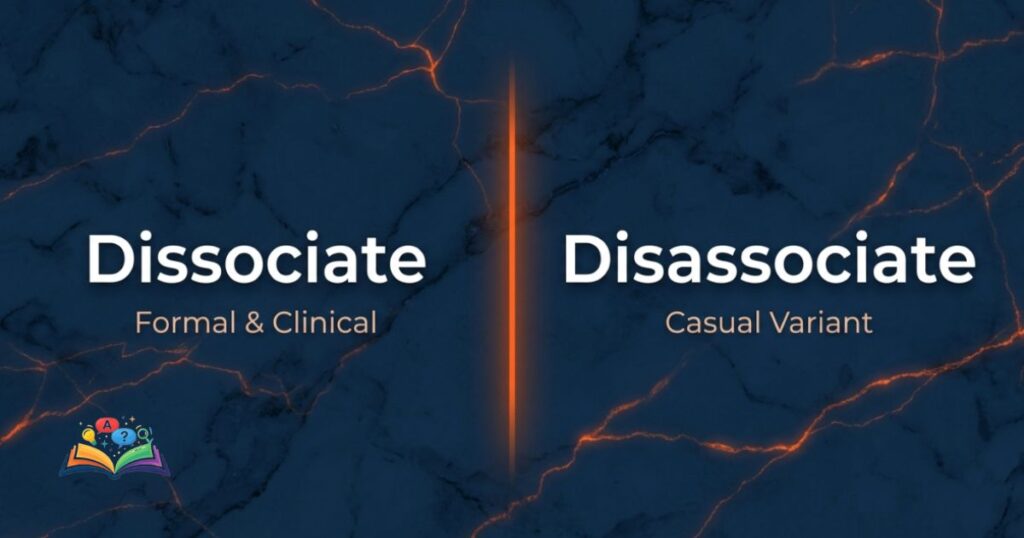
| Word | Status | Best Use Case |
| Dissociate | Correct (Original) | Science, psychology, formal writing |
| Disassociate | Correct (Variant) | Casual conversation, informal writing |
Dissociate Or Disassociate In Psychology And Mental Health
In clinical settings, precision matters, and mental health professionals strongly favor one specific term over the other. Review the subsections below to see how medical experts define this state and how it compares to similar psychological conditions. Choose the correct terminology to ensure your clinical writing remains accurate.
Defining The Act Of Dissociating From Reality
The mental health definition exclusively uses the term “dissociate.” The Diagnostic and Statistical Manual of Mental Disorders (DSM-5) categorizes these experiences under “dissociative disorders,” not “disassociative disorders.”
When a person experiences severe stress or trauma, their thoughts might feel disorganized or unorganized, leading to a mental disconnect from their surroundings, memories, or identity. This coping mechanism is strictly referred to as dissociation. If you are writing a psychology paper, always drop the extra letters and use the original spelling.
Dissociation Vs Depersonalization And Derealization
Dissociation is a broad umbrella term for feeling disconnected from reality. Under this umbrella sit specific conditions like depersonalization and derealization. Depersonalization involves feeling detached from your own body or mind, as if you are watching yourself from the outside. Derealization is the feeling that the outside world is distorted, fake, or dreamlike.
These diagnoses are not strictly exclusive or inclusive of one another, as a patient can experience both simultaneously during a severe dissociative episode.
Dissociation Or Disassociation In Chemistry And Science
Scientific research, whether relying on quantitative or qualitative data, requires exact terminology. In chemistry, the only correct term is dissociation.
Dissociation in chemistry refers to the process where molecules separate into smaller atoms, ions, or radicals. For example, when observing how salt molecules break down in liquids, solids, or gasses or gases, scientists refer to the process as electrolytic dissociation. You will never see “disassociation” in a credible science textbook.
How To Properly Pronounce Dissociate And Disassociate
Just as writers debate whether a word is spelled or spelt correctly based on their region, speakers often hesitate on pronunciation.
- Dissociate: Pronounced as dih-SOH-see-ate. Some regions also pronounce it as dih-SOH-shee-ate.
- Disassociate: Pronounced as dis-uh-SOH-see-ate.
The extra syllable in “disassociate” makes it slightly harder to say quickly, which is another reason formal editors prefer the shorter, original version.
Better Alternatives And Synonyms For Dissociate
If you want to avoid the debate entirely, you can use clearer words to express separation. Selecting a clear synonym can act as a useful aid or aide when writing professional reports or avoiding repetitive language.
Instead of using either term, consider these strong synonyms:
- Separate: Best for physical objects or people.
- Disconnect: Ideal for digital technology or abstract concepts.
- Detach: Works well for emotional boundaries.
- Sever: A strong word for permanently cutting ties.
- Isolate: Useful for scientific or medical contexts.
Final Clarity On Dissociate Or Disassociate
Both words are structurally correct and acceptable in standard US English. Taking this concept farther or further into your daily writing, remember that consistency is your best tool.
If you are writing a casual blog post or speaking with a friend, use whichever word comes to mind first. If you are writing for medicine, psychology, chemistry, or formal publication, always choose “dissociate.” It is cleaner, older, and universally accepted as the absolute standard form.
Common Questions About Dissociate Or Disassociate
Are dissociate and disassociate the same? Yes, both words have the exact same definition. They both mean to break ties, separate, or disconnect from a person, group, or concept.
Why do people say disassociate instead of dissociate? People say “disassociate” because it combines the familiar prefix “dis” with the common word “associate.” This combination feels more logical to modern English speakers than using the older root word “sociate.”
What does it mean for a person to disassociate? In casual terms, it means to distance yourself from a toxic situation or person. In psychological terms, it refers to an involuntary mental disconnect from reality, memories, or your own body due to stress or trauma.
How can I tell if I am dissociating? Signs of dissociation include feeling emotionally numb, feeling like your surroundings are not real, forgetting chunks of time, or feeling like you are observing your life from outside your body. Always consult a medical professional for an accurate diagnosis.
Is disassociate an incorrect spelling? No. Major dictionaries recognize “disassociate” as a valid word. It is considered an acceptable variant, though formal editors and scientific journals prefer the original spelling of “dissociate.”