If you have ever paused while writing and wondered if you should use farther or further, you are dealing with one of the most common word-choice questions in English.
The good news is that the distinction is fairly simple. In most cases, farther relates to physical distance, while further relates to time, progress, ideas, or something additional. This guide explains the difference, shows real examples, and helps you choose the correct word with confidence.
Why Farther And Further Are Frequently Confused
Farther and further sound similar, share a related history, and are often used interchangeably in everyday conversation. Many style guides acknowledge that overlap, which adds to the confusion.
In modern American English, however, a practical distinction exists. Understanding that distinction makes writing clearer and more precise.
The Core Rule For Choosing Farther Or Further
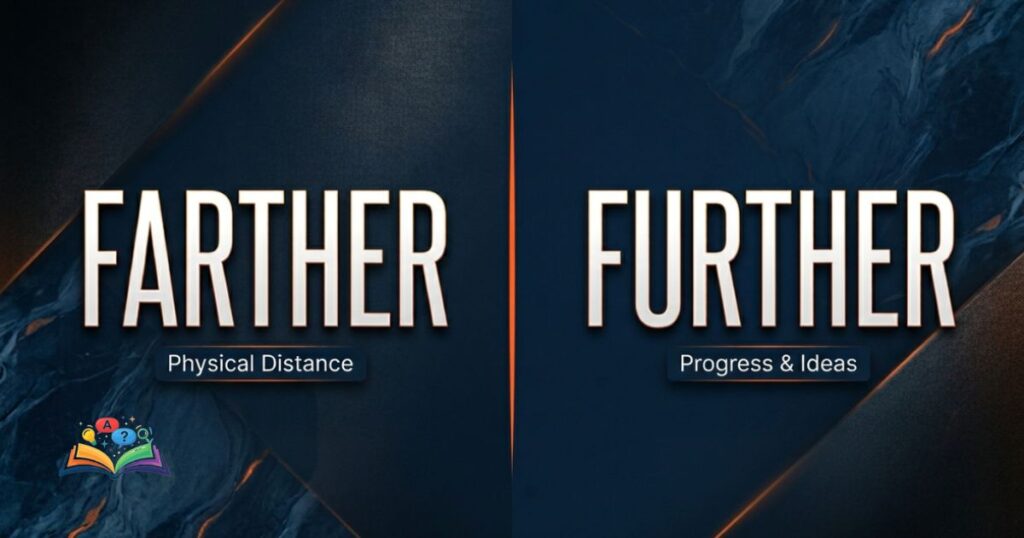
Farther is generally used for measurable physical distance. Further is generally used for figurative distance, time, progress, advancement, or additional information.
| Word | Typical Use | Example |
| Farther | Physical distance | We walked farther than expected. |
| Further | Time, ideas, progress, addition | We need further discussion. |
Correct Usage
- The gas station is farther down the highway.
- We cannot move further until approval arrives.
- Her house is farther from downtown.
- Further research is needed.
How Farther Works When Talking About Physical Distance
When the distance can be measured in feet, miles, yards, or any physical unit, farther is usually the preferred choice.
Correct:
- Chicago is farther from Los Angeles than Denver is.
- She ran farther than anyone on the team.
- The trail extends farther into the mountains.
Incorrect:
- She ran further than anyone on the team. (Less precise for physical distance)
American style guides often recommend using farther whenever actual distance is involved.
For more word-choice guidance, see this collection of correct word usage guides.
How Further Works When Talking About Time, Progress, And Ideas
Unlike farther, further is not limited to physical movement.
It commonly refers to:
- Progress
- Advancement
- Time
- Abstract concepts
- Additional information
Examples:
- We need further investigation.
- The project is further along than expected.
- Further updates will be provided next week.
- Their negotiations went further than anyone predicted.
In these cases, physical distance is not being measured.
Farther Or Further Away: Which Version Sounds Most Natural?
Both expressions appear in modern English, but the choice depends on context.
Use farther away when discussing physical distance.
- The airport is farther away than I thought.
Use further away when discussing abstract ideas.
- A solution seems further away than ever.
In casual speech, many Americans use either form, but formal writing benefits from the distinction.
Farther Or Further From The Truth: Why Further Is Preferred
The phrase “further from the truth” is the standard expression because truth is an abstract concept rather than a measurable location.
Correct:
- Nothing could be further from the truth.
Not Preferred:
- Nothing could be farther from the truth.
Although some speakers use both versions, further remains the established choice.
Farther Or Further Along: Which Fits Progress And Development?
When discussing growth, advancement, or stages of completion, further along is usually correct.
Examples include:
- The construction project is further along than last month.
- She is further along in her career.
- The negotiations moved further along after the meeting.
Since progress is abstract, further is the natural fit.
For another common usage comparison, see will or would in English grammar.
Farther Or Further Down The Road: Literal Road Or Future Possibility?
This expression can use either word depending on meaning.
Literal Distance
- The rest stop is farther down the road.
Future Events Or Possibilities
- We may revisit that issue further down the road.
A physical road calls for farther. A future situation calls for further.
Go Farther Or Further? Common Verbs That Create Confusion
Several verbs frequently appear with both words.
| Expression | Preferred Form |
| Walk farther | Physical distance |
| Run farther | Physical distance |
| Travel farther | Physical distance |
| Move further ahead | Progress |
| Further improve | Advancement |
| Further develop | Advancement |
Examples:
- The new vehicle can go farther on one tank of gas.
- Education can take you further in your career.
- She traveled farther than expected.
- The discussion went further than planned.
Farther Vs Further In American English And British English
American English tends to maintain the distance-versus-abstraction distinction more consistently.
British English sometimes uses further for both meanings.
American English
- Farther = physical distance
- Further = abstract distance or addition
British English
- Further often covers both uses
- Farther appears less frequently
This pattern is similar to differences seen in articles such as math or maths and mom or mum.
Common Grammar Mistakes With Farther And Further
Writers often make these mistakes:
Using Farther For Abstract Concepts
❌ We need farther discussion.
✅ We need further discussion.
Using Further For Measurable Distance
❌ The store is further down the street.
✅ The store is farther down the street.
Mixing Literal And Figurative Meanings
Always identify whether you are discussing actual distance or an abstract concept.
For another frequently confused pair, compare aid or aide.
Sentence Patterns That Make Choosing Farther Or Further Easy
These common patterns make the choice straightforward.
| Phrase | Preferred Word |
| How much farther? | Farther |
| Much farther away | Farther |
| One step farther | Farther |
| Further information | Further |
| Further action | Further |
| Further discussion | Further |
Quick test:
If you can measure it with a ruler, mile marker, or map, choose farther.
If you cannot physically measure it, choose further.
Farther, Further, Farthest, And Furthest In The Same Family Of Words
These words follow similar patterns.
| Word | Typical Meaning |
| Farther | Greater physical distance |
| Farthest | Greatest physical distance |
| Further | Additional or abstract advancement |
| Furthest | Greatest abstract extent |
Examples:
- Alaska is the farthest state from Florida.
- That is the furthest point we can take this argument.
Related grammar distinctions also appear in articles like spelled or spelt, dove or dived, and shrank or shrunk.

Real-World Farther Vs Further Usage Across Formal And Informal Writing
Formal writing generally follows the traditional distinction.
Academic Writing
- Further analysis
- Further evidence
- Further study
Business Writing
- Further action
- Further review
- Further approval
Everyday Conversation
People often mix the two words without causing confusion.
For similar usage questions, compare while vs whilst, criteria or criterion, master’s or masters, sell or sale, and disorganized or unorganized.
Final Clarity On Farther Or Further
The simplest rule is this:
- Use farther for physical distance.
- Use further for time, progress, ideas, additional information, or figurative distance.
While some overlap exists in modern English, following this guideline keeps your writing clear, polished, and consistent.
Common Questions About Farther Or Further
How Do You Use Further And Farther?
Use farther for measurable physical distance and further for abstract ideas, progress, time, or additional information.
What Is The Rule For Further And Farther?
Farther relates to physical distance. Further relates to figurative distance, advancement, and addition.
Is It Run Farther Or Further?
Run farther is preferred because running involves physical distance.
Do You Walk Further Or Farther?
Walk farther is usually correct when discussing distance traveled.
Is It Further Or Farther When Talking About Time?
Use further when discussing time or future progress.
Will Take You Farther Or Further?
Both can be correct. Physical travel usually takes you farther. Career growth or success usually takes you further.
Is It Correct To Say Further?
Yes. Further is a standard and widely accepted English word.
Is Farther A Real Word?
Yes. Farther is the comparative form traditionally associated with physical distance.
Why Do Americans Say Farther?
American English often preserves the distinction between physical distance (farther) and abstract concepts (further).
What Is Another Word For Farther?
Depending on context, alternatives include “more distant,” “beyond,” or “at a greater distance.”