If you’ve ever been asked “heads or tails?” before a game, a bet, or a simple decision, you’ve already taken part in one of the oldest methods of random selection. A heads or tails coin toss is quick, simple, and widely accepted as a fair way to choose between two options.
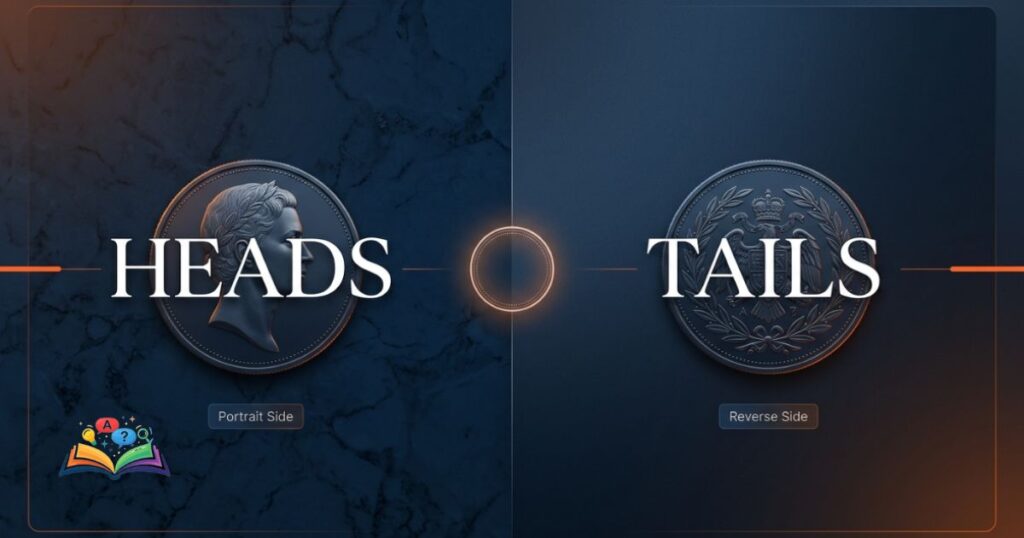
The phrase heads or tails refers to the two sides of a coin. One side typically displays a person’s portrait or national symbol, called the head, while the opposite side is known as the tail. This guide explains how heads or tails works, why people trust coin flips, common expressions tied to the phrase, and how digital coin toss tools compare to physical coins.
What Heads Or Tails Refers To In A Coin Toss
Heads or tails refers to the two possible outcomes when a coin is flipped into the air and lands on one side.
In the United States, the “heads” side usually features a portrait, such as Abraham Lincoln on a penny or George Washington on a quarter. The opposite side is commonly called “tails.”
| Term | Description |
| Heads | Side showing a portrait or primary national image |
| Tails | Opposite side of the coin |
| Coin Toss | The act of flipping a coin to produce a random outcome |
A coin toss produces only two possible results:
- Heads
- Tails
This simplicity is why coin flips are often used when two choices have equal value.
For more common expressions and phrases, see our guide to popular words and phrases.
How To Call Heads Or Tails Correctly During A Coin Flip
A coin toss follows a simple process, but there are accepted rules that make the outcome fair. Before the coin is flipped, one person calls either heads or tails.
The sections below explain exactly when the call should happen and what occurs after the coin lands.
When The Call Must Be Made
The call should happen before the coin leaves the flipper’s hand.
A standard sequence looks like this:
- One person chooses heads or tails.
- The coin is flipped.
- The coin lands.
- The result is announced.
Calling after seeing the result defeats the purpose of randomness.
What Happens If The Coin Lands On The Opposite Side
If you call heads and the coin lands tails up, you lose the toss.
For example:
| Your Call | Result | Outcome |
| Heads | Heads | Win |
| Heads | Tails | Lose |
| Tails | Heads | Lose |
| Tails | Tails | Win |
The process is straightforward because there are only two possible outcomes.
Why Heads Or Tails Is Used To Make Fair Decisions
A heads or tails coin flip is often viewed as a neutral way to settle a choice. Because each side has nearly the same chance of appearing, neither option is supposed to have an advantage.
Below are some of the most common situations where people use coin tosses.
- Choosing who goes first in a game
- Settling minor disagreements
- Selecting teams
- Breaking ties
- Making simple decisions between two equal options
For example:
- “Let’s flip a coin to see who drives.”
- “Call heads or tails before I toss it.”
The fairness of the process is what makes it so popular.
Is Heads Or Tails Truly Random?
A properly flipped coin is considered approximately 50/50.
That means:
- Heads has about a 50% chance.
- Tails has about a 50% chance.
Probability Of A Coin Toss
| Outcome | Probability |
| Heads | 50% |
| Tails | 50% |
Although coin tosses are generally treated as random, some researchers have shown that factors such as flipping technique and surface conditions can create slight biases.
For everyday decisions, however, a coin toss remains one of the simplest randomization methods available.
Heads Or Tails In Sports, Games, And Competitions
Sports organizations often use coin tosses to determine important starting conditions.
Common examples include:
- NFL games
- College football games
- Cricket matches
- Local sports leagues
- Tournament brackets
In football, the winning team often chooses whether to receive the kickoff or defer possession.
Coin tosses also appear in:
- Board games
- Classroom activities
- Trivia competitions
- Party games
The method is trusted because everyone can see the result.
Why Many People Prefer Calling Heads Instead Of Tails
Many people instinctively choose heads when given the option.
Several theories explain this behavior:
- Heads is often mentioned first.
- Portrait sides receive more visual attention.
- People tend to prefer familiar images.
Interestingly, preference does not increase the actual odds of winning.
Common Misconception
Incorrect belief: Heads comes up more often.
Reality: A fair coin gives heads and tails roughly equal chances over time.
If you are interested in other commonly misunderstood terms, compare usage patterns in our guide to sub or dub.
Common Expressions And Slang Related To Heads Or Tails
The phrase extends beyond physical coin tossing.
People often use it figuratively when outcomes appear evenly balanced.
Examples include:
- “It’s basically heads or tails at this point.”
- “The election feels like a heads or tails situation.”
- “Either choice works, it’s heads or tails.”
In slang or casual conversation, the phrase can suggest:
- Uncertainty
- Equal odds
- A difficult choice
- Random chance
This type of figurative language appears throughout American English.
Digital Alternatives To A Physical Heads Or Tails Coin
Physical coins are no longer necessary.
Today, people can use:
- Heads or tails generators
- Virtual coin toss apps
- Google coin flip tools
- Heads or tails spinners
- Random decision websites
Popular searches include:
- Heads or tails generator
- Google heads or tails
- Flip a coin
- Heads or tails coin flip
Digital tools replicate the same basic concept while eliminating the need for a real coin.
People looking at how words and expressions vary across cultures may also enjoy our comparison of aloha or mahalo.
Heads Or Tails In Movies, Pop Culture, And Entertainment
Coin tosses have become a recognizable storytelling device.
Writers often use heads or tails moments to symbolize:
- Fate
- Luck
- Chance
- Destiny
- Risk
Many films feature dramatic coin toss scenes because audiences instantly understand the stakes.
Popular entertainment-related searches include:
- Heads or Tails movie
- Heads or Tails 2025 film
- Heads or Tails Super Bowl references
The phrase remains a powerful symbol because everyone understands the underlying concept.
Questions People Often Ask Before Flipping A Coin
People frequently have questions about how a coin toss works and whether one side offers any advantage.
The answers below address some of the most common concerns before a flip takes place.
- Does heads come up more often?
- Is tails luckier?
- Should I always choose heads?
- Can a coin land on its edge?
In practical terms, heads and tails are intended to be equally likely outcomes.
Heads Or Tails Usage In Everyday Conversation
The phrase appears regularly in daily speech.
Examples include:
Correct Usage
- “Let’s settle it with heads or tails.”
- “Call heads or tails before I flip.”
- “It’s a heads or tails decision.”
Less Natural Usage
- “Let’s choose a heads and tails.”
- “I picked a heads.”
Notice that the standard phrase remains “heads or tails.”
Many expressions evolve over time, much like modern slang terms discussed in our article on bougie or boujee.
Final Clarity On Heads Or Tails
Heads or tails is the traditional phrase used when flipping a coin to create a random outcome between two choices. The caller selects either heads or tails before the toss, and the side facing upward determines the winner.
Because it is simple, fast, and generally fair, the heads or tails coin toss remains one of the most widely used decision-making methods in sports, games, and everyday life.
Common Questions About Heads Or Tails
Do Heads Or Tails For Me?
If you need a quick random result, imagine a coin flip. For a truly random outcome, use a physical coin or a digital coin flip tool.
Is It A Head Or A Tail?
A coin has two sides. The portrait side is usually called heads, while the opposite side is called tails.
Why Do People Say Heads Or Tails?
People use the phrase because it identifies the two possible outcomes of a coin toss.
Who Came Up With Heads Or Tails?
Coin-based decision making dates back thousands of years. Ancient civilizations used coins and similar objects to make random choices long before modern coins existed.
What Do Heads And Tails Symbolize?
Heads and tails often symbolize chance, fate, probability, and decision-making.
Is Heads Or Tails Good Luck?
Neither side is inherently luckier. On a fair coin, heads and tails have approximately equal odds of appearing.