
We have all felt the temptation to skip out on our daily responsibilities to enjoy a beautiful sunny day or simply take an unexpected break. When you decide to skip school or work without permission, you are participating in a time honored American tradition of skipping out. However, writing about this act of playing truant often brings up a frustrating linguistic roadblock.
The confusion between hooky and hookie is incredibly widespread, leading many people to hesitate before they hit send on a message or type out a search query. Because English spelling rules can be unpredictable, it is easy to see why this slang term causes so much doubt.
This comprehensive guide clears up the spelling confusion immediately. You will learn the correct way to spell this popular slang term, why the alternative version fails to meet standard English criteria, and where the expression comes from. We will also break down some common linguistic lookalikes that confuse writers across the United States.
Why Hooky Is the Only Lexically Correct Spelling
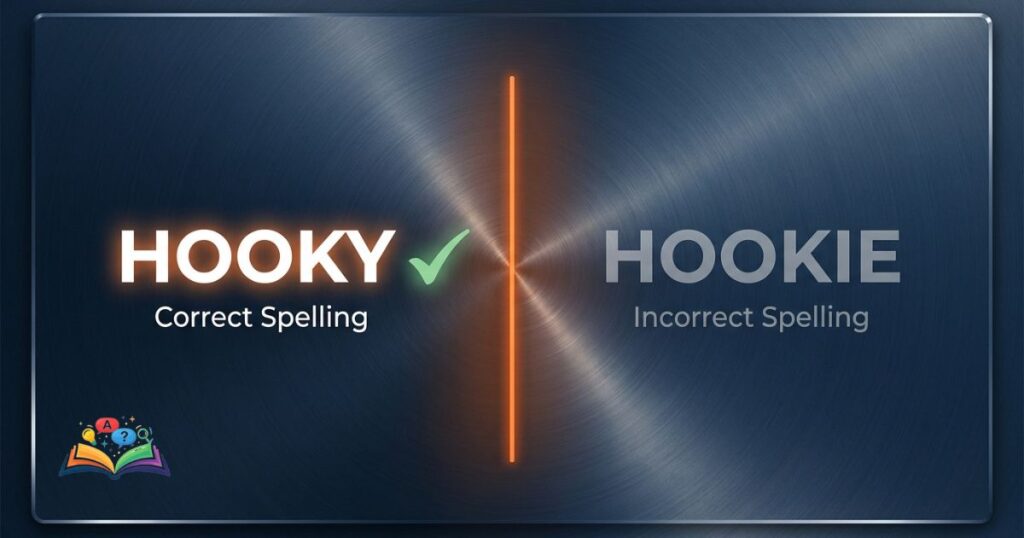
The correct spelling is hooky. Hookie is a common misspelling that is not recognized as a standard word by major American dictionaries, including Merriam Webster and American Heritage. The proper form uses a single y at the end to turn the base noun hook into an informal noun and adjective phrase.
While English speakers often use the ie ending for casual terms, standard language conventions favor the y suffix for this specific idiom. When you write about skipping out on your obligations, always use hooky to maintain proper grammar and avoid spelling errors.
Why Hookie Is Formally Considered a Spelling Error
The variation spelled with an ie is incorrect because it violates the established orthographic history of this specific American idiom. People often default to this spelling because they confuse it with words like doggy or doggie, where both variations are accepted in casual text. However, hooky does not share that flexibility.
Writing hookie in a text message or an email is a noticeable slip up. Editors and spellcheckers flag it as an error because the word has been set in stone with a y ending for over a century. Sticking to the validated spelling ensures your writing remains accurate and professional.
Decoding the Linguistic Slang: What Does It Mean to Play Hooky?
Understanding the actual mechanics of this phrase requires looking at how Americans talk about unexcused absences. If you want to master this idiom completely, it helps to look at its modern application. Read on to see how the phrase operates in daily conversations and professional environments.
To play hooky means to stay away from school, work, or any other official commitment without a valid excuse or prior permission. It is not used for pre approved vacation days or official sick leave. Instead, it describes a spontaneous, unauthorized absence, usually motivated by a desire for leisure rather than actual illness.
In the United States, the phrase carries a slightly nostalgic, mischievous connotation rather than a malicious one. While truancy is a serious matter for school districts, saying someone is playing hooky usually implies a harmless day of relaxation or personal time.
Real-World Context: Hooky Usage Sentences and Modern Examples
The best way to solidify your grasp of this word is to observe it in action within standard sentences. The following examples show how to use the term correctly in various contexts:
- The high school principal noticed a sudden drop in attendance when the local amusement park opened for the season.
- Instead of logging into his remote workstation on Friday morning, Mark decided to play hooky and spend the day at the golf course.
- Sarah felt guilty about skipping her morning college lecture, realizing that playing hooky was setting her back before finals.
To help you avoid common writing traps, look at this quick comparison table:
| Correct Usage | Incorrect Usage |
| They are playing hooky today. | They are playing hookie today. |
| He loves to hooky from class. | He loves to hookie from class. |
| A classic hooky day at the beach. | A classic hookie day at the beach. |
Etymology Spotlight: Where Did the Phrase Playing Hooky Originate?
The history of this slang term traces back to 19th-century America, with New York roots. To trace how a simple word turned into a national phrase, we can look at the cultural shifts of that era. Review the historical context below to understand how the expression evolved.
Etymologists trace the origin of the phrase back to the old Dutch word hoeken, which means to hide or to catch hook. In the 1800s, New York had a massive influx of Dutch cultural influences. Schoolchildren in New York City began using the term hook it to describe running away or escaping from authorities.
By the 1840s, this slang evolved into playing hooky, specifically referring to students who hid from the truant officer. The phrase captured the imagination of the public and spread rapidly across the United States, cementing itself into the American vocabulary.
Deconstructing What Hooky Used to Be Called in Early English
Before hooky became the dominant term in American English, people used a wide variety of regional phrases to describe an unexcused absence from school. In old English traditions, skipping school was often called playing truant, a formal term that still exists in legal and educational frameworks today.
Other regional slang terms included miching, skipping lectures, or cutting class. While British students might talk about bunking off or wagging, American culture heavily favored hooky. Over time, the term expanded from classrooms to offices, becoming the definitive casual expression for avoiding responsibilities.
Linguistic Lookalikes: Dissecting Hooky, Hokey, and Hokie
English is full of words that sound remarkably similar but have entirely different meanings and spellings. These linguistic lookalikes often cause confusion for writers trying to master English vocabulary. We will examine a few specific terms that often get mixed up with our primary keyword.
The Stark Contrast Between the Hokey Pokey and the Hokey Cokey
People often confuse hooky with hokey, which means cheesy, contrived, or overly sentimental. This confusion extends to the famous novelty dance known in the United States as the Hokey Pokey.
In the United Kingdom, this exact same participatory dance is called the Hokey Cokey. Neither of these musical terms has anything to do with skipping school or work. Mixing up these terms can turn a sentence about skipping work into a confusing statement about a children’s dance party.
What the Heck Is a Virginia Tech Hokie anyway?
Another major source of confusion, especially in sports and American higher education, is the term Hokie. Capitalized with an ie, a Hokie is the official nickname for a student or athlete at Virginia Polytechnic Institute and State University, commonly known as Virginia Tech.
The term originated from a spirit cheer written by a student named O.M. Stull in 1896. Stull made up the word solely to grab attention during a contest. Today, the Virginia Tech Hokie mascot looks like a stylized turkey, which has absolutely no connection to the act of playing hooky.

Final Clarity on the Hooky or Hookie Dilemma
When you need to choose between these two spellings, remember that hooky is the only option supported by standard American English dictionaries. The version ending in ie is a modern spelling error driven by a misunderstanding of how suffixes apply to the word hook.
Keeping these terms distinct ensures your communication is flawless. If you want to master other tricky words, look into our guide on handling stationary or stationery without making a mistake. You can also review how to differentiate between sweet or sweat to keep your vocabulary sharp.
For additional language support, browse our resources on peeking or peaking to make sure your professional emails are always accurate. If you want to clear up more common spelling slip ups, check out our master list of commonly confused words to elevate your writing confidence.
Common Questions About the Spelling and Usage of Hooky
Is the Term Hooky Appropriate and Safe for 12-Year-Olds?
Yes, the term hooky is entirely safe and appropriate for 12-year-olds. It is a mild, G-rated slang term used in everyday conversation to describe skipping school. The word contains no offensive, vulgar, or inappropriate connotations.
Is There Any Modern Representation or LGBT Content in the Hooky Webtoon?
Yes, the popular Webtoon comic series titled Hooky by Míriam Bonastre Tur contains positive LGBT representation. As the fantasy plot progresses and characters mature, romantic relationships develop, including canonical queer representation among the main cast.
Is It Morally or Professionally Wrong to Play Hooky From Work?
Professionally, playing hooky can put your employment at risk if you get caught, as it involves taking unauthorized time off under false pretenses. While many people view a rare mental health day as harmless, it is usually safer to use official paid time off to avoid violating company policies.
What is the main difference between playing hooky and taking a sick day?
Playing hooky is an unauthorized, spontaneous absence taken for fun or leisure without telling your manager ahead of time. A sick day is a formal, legitimate use of company benefits intended for physical recovery, medical appointments, or mental wellness.
Are there other words like hooky that end in a y instead of ie?
Yes, many American English terms follow this pattern. For example, when choosing between bingeing or binging, spelling patterns can vary, but casual adjectives often lean heavily on a single y. You can see similar structural rules when analyzing doggy or doggie, though hooky remains strict about its final letter.