
If you are unsure whether “shelf” or “shelve” is correct, the right word depends entirely on how you use it in a sentence. Confusion happens because both words relate to storage, but one is a physical object while the other is an action.
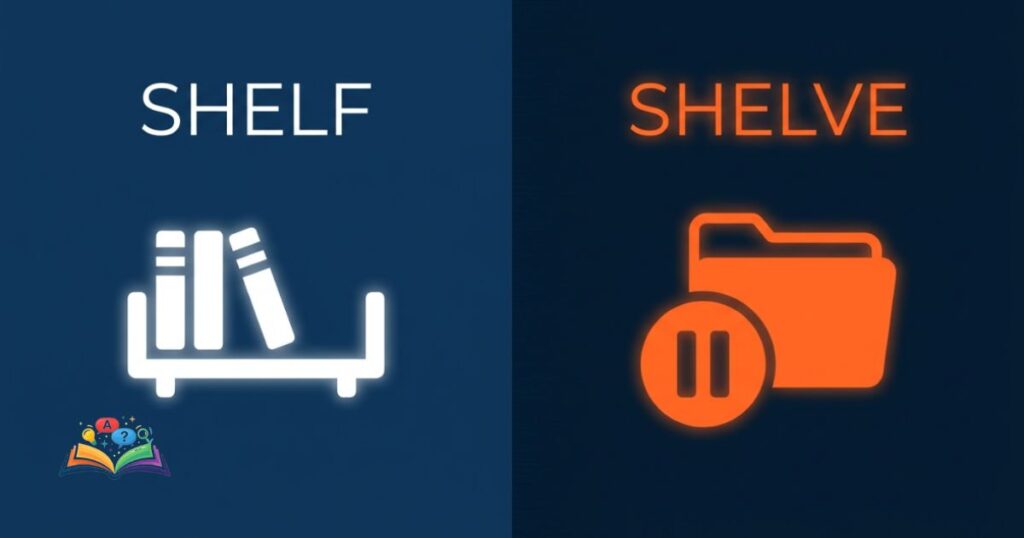
The short answer comes down to basic parts of speech: “shelf” is a noun, and “shelve” is a verb. Mixing them up can make your writing look unprofessional, especially in business communications or academic assignments.
This complete guide breaks down the core grammar rules, plural forms, common idioms, and real-world examples. By understanding how these terms function in US English, you can always choose the right word with total confidence.
Core Grammar Rules: Distinguishing a Noun Shelf or Verb Shelve
Understanding the structural difference between these terms keeps your writing clear and precise. Recognizing parts of speech helps prevent common grammatical slips across many daily word choices. Review the detailed breakdowns below to master the specific mechanics of each word.
Do You Shelf Something or Shelve Something?
You always “shelve” something when referring to the action. English speakers do not use “shelf” as a standard action word. Saying “I need to shelf these books” is grammatically incorrect in standard US writing. Instead, say “I need to shelve these books.”
What Is the Verb to Shelve and How Is It Used?
The verb “to shelve” means to place items on a flat storage surface, but it also has a common figurative meaning: to put off, delay, or discard an idea or plan. This mirrors other action-oriented vocabulary patterns, such as understanding when to use will or would when discussing future or hypothetical actions.
- Physical action: The stocker will shelve the incoming inventory tonight.
- Figurative action: The committee decided to shelve the expansion project until budget numbers improve.
Pluralization Rules: How Shelf or Shelve Forms Become Shelves
Pluralizing certain English words requires altering the ending consonants rather than simply adding an “s.” This structural transition follows specific historical patterns that remain active in modern writing. Take a look at how this spelling shift occurs when moving from singular to plural forms.
Is Shelves Plural for Shelf or Shelve?
“Shelves” is the plural form of the noun “shelf.” It is not the plural form of “shelve,” because verbs do not have plural forms in this manner; verbs conjugate based on their subject. When you talk about multiple storage boards, the “f” transforms into a “v” before adding “es.” This exact pattern appears in similar words like thieves or thiefs, where the “f” sound shifts to a “v” sound in the plural form.
How Did Shelves Become the Plural Form?
Old English phonetic rules dictated that an “f” sound located between two vowels morphed into a voiced “v” sound. Over time, the written spelling updated to reflect this pronunciation shift. This same linguistic heritage explains why elfs or elves follows the exact same transformation pattern, along with wolves or wolfs in traditional English usage.
Is It Bookshelves or Bookshelf in Everyday Writing?
Use “bookshelf” when describing a single unit designed to hold reading material, and use “bookshelves” for two or more units. The compound word strictly inherits the standard pluralization rule of its base noun.
- Singular: The mahogany bookshelf sits in the corner of the office.
- Plural: We spent the weekend assembling three new bookshelves for the library.

Idioms and Slang: Common Phrases Using Shelf or Shelve
Figurative expressions frequently rely on storage terms to communicate abstract ideas about quality, expiration, and project management. Navigating these phrases correctly ensures your writing sounds natural to native English speakers. Explore the most common idiomatic usages detailed below.
Is It Top Shelf or Top Shelve in Casual Speech?
The correct expression is “top shelf,” utilizing the noun form as an adjective. Originating from bars keeping high-end liquor on the highest physical display, the phrase describes something of superior quality or highest excellence.
- Incorrect: That restaurant offers top shelve service.
- Correct: That restaurant offers top shelf service.
Is It Shelf Life or Shelve Life for Product Expiration?
The correct phrase is “shelf life.” This compound noun measures how long a packaged product remains fresh, usable, or safe while sitting on a store rack. The usage hinges on the physical location (the noun) rather than the act of storing it. Similar subtle usage nuances exist across modern English vocabulary, such as choosing between disorganized or unorganized when describing chaotic conditions.
Is It “Shelf It” or “Shelve It” When Delaying Plans?
When instructing someone to pause or abandon a project, the correct phrase is “shelve it.” Because the phrase commands an action, it requires the verb form. Writing “let’s shelf it” is a common error in professional emails.
- Incorrect: Let’s shelf the marketing proposal for now.
- Correct: Let’s shelve the marketing proposal for now.
Practical Context: Do You Shelf Books or Shelve Books?
Applying these rules in daily writing requires paying attention to sentence structure and context clues. Whether describing home decor or physical organization, selecting the proper term ensures clarity. Read through these practical context guidelines to refine your usage.
Context Clues for Storage, Decor, and Furniture
Look at the words surrounding your target term to determine the correct selection. Prepositions like “on,” “under,” or “above” typically point toward the physical noun. Action indicators like “to,” “will,” or “should” signal that the verb form is required.
- Preposition clue (Noun): Place the vase directly on the shelf.
- Action clue (Verb): You need to shelve those returned items before closing.
Is It “In the Shelves” or “On the Shelves”?
In standard American English, objects sit on the shelves, not in them. Because a shelf is an open, flat surface rather than an enclosed container, “on” represents the correct spatial preposition.
- Incorrect: The groceries are stored in the shelves.
- Correct: The groceries are stored on the shelves.
Sentence Examples: How to Use Shelf or Shelve Correctly
Seeing words used in context reinforces correct habits and highlights subtle grammar distinctions. Reviewing practical examples across home and business environments makes identifying errors easier. The sentence pairs below demonstrate proper usage across everyday situations.
- Correct (Noun): He built a custom wall shelf out of reclaimed oak.
- Incorrect (Noun): He built a custom wall shelve out of reclaimed oak.
- Correct (Verb): Executives decided to shelve the software update until next year.
- Incorrect (Verb): Executives decided to shelf the software update until next year.
- Correct (Plural): The library added six new shelves to accommodate the donation.
- Incorrect (Plural): The library added six new shelfs to accommodate the donation.
Consistent attention to word selection reflects broad attention to clear communication, whether you are sorting out vocabulary or reviewing essential correct word usage across complex topics.
Final Clarity On Choosing Between Shelf or Shelve
Distinguishing between these two terms becomes easy once you separate physical objects from actions. Remember that “shelf” refers to the object sitting on your wall, while “shelve” is the action of putting something away or putting a plan on hold. Pluralize the physical object as “shelves,” and reserve the verb form for actions and idioms like “shelve it.” Keeping this simple distinction in mind prevents writing errors and ensures your communication remains clear and professional.
Frequently Asked Questions About Shelf or Shelve
Is “Shelve” a Word or Just a Misspelling?
“Shelve” is a completely legitimate English verb, not a misspelling. It means to place something on a storage surface or to temporarily stop work on a plan or project.
What Is a Group of Shelves Called?
A group of connected storage surfaces is commonly called a “shelving unit,” a “bookcase,” a “rack,” or a “suite of shelves.”
What Is a Collective Noun or Synonym for Shelf?
Common synonyms for a physical shelf include “ledge,” “rack,” “counter,” or “bracket.” When referring to the verb “shelve,” accurate synonyms include “postpone,” “defer,” “table,” or “mothball.”
Is “Shelfs” Ever Correct in English?
No, “shelfs” is an incorrect spelling in standard English. The proper plural form of the noun “shelf” is always “shelves.”
Is It “Top Shelf” or “Top Shelve” Whiskey?
It is always “top shelf” whiskey. The term uses the noun form as an adjective to indicate premium quality liquor stored on the highest display rack.