It is incredibly common for English learners—and even native speakers—to hesitate when choosing between “will” and “would.” Because both modal verbs talk about choices, future situations, or requests, they are easy to confuse. However, the rule of thumb is simpler than it looks: will generally indicates certainty or a definite future action, while would introduces politeness, conditions, habits, or hypothetical scenarios.
If you enjoy exploring grammar nuances, such as whether to write spelled or spelt, this comprehensive guide will help clear up this everyday language hurdle.
The Basics of Will Or Would: The Quickest Way To Choose
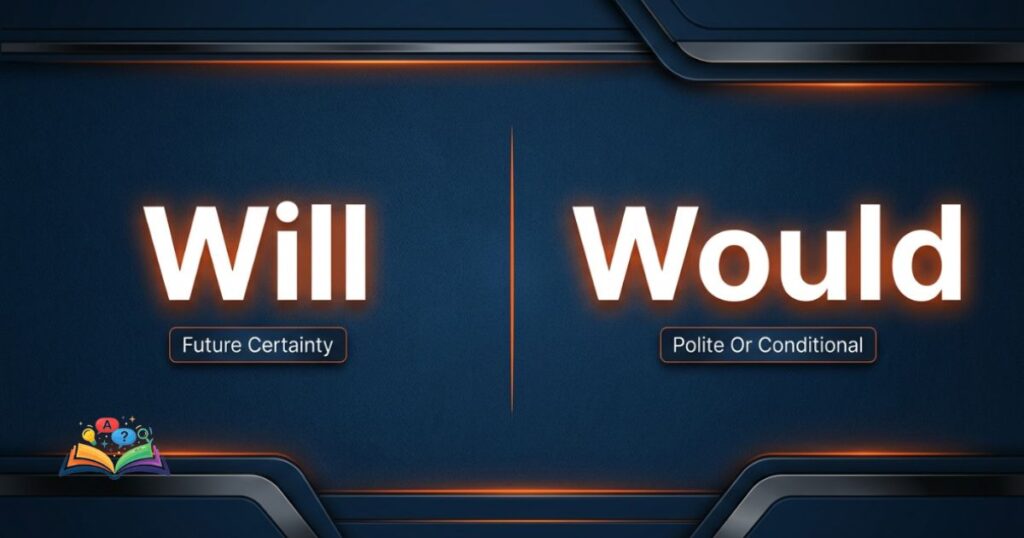
The fastest way to decide which word fits your sentence is to look at the level of certainty. Will is your go-to word for future actions, guaranteed promises, and firm decisions. On the other hand, would softens the tone, making it ideal for polite requests, imagined situations, and conditional phrases.
| Word | Core Meaning | Example Sentence |
| Will | Definite future or certainty | I will finish the report tonight. |
| Would | Polite, imagined, or conditional | I would finish the report if I had my laptop. |
A quick trick to remember: Will = certain, whereas Would = possible, imagined, or polite.
Understanding Will Or Would For Future Actions And Promises
When you expect something to happen without a doubt, “will” is the correct choice. You will hear this constantly in business communications, daily planning, and whenever people make predictions based on strong beliefs.
For example, when making a promise, you want to sound confident and committed.
- Prediction: The package will arrive by Friday.
- Instant Decision: I will get the door for you!
- Strong Promise: We will refund your money immediately.
Saying “I would get the door for you” sounds unnatural unless you add a condition (like “…if my hands weren’t full”). If you regularly dissect verb forms, such as the rules for shrank or shrunk, understanding this shift in certainty will feel very familiar.
Softening Requests: When To Use Will Or Would In Conversation
In spoken English, particularly in American and British regions, “would” is heavily utilized to create a respectful distance. Using “will” can sometimes feel too direct or demanding.
Compare these two requests:
- Will you open the window? (Direct, slightly demanding)
- Would you open the window? (Polite, softer)
This subtle shift can completely change the tone of an email or a conversation. Similar to how regional dialects prefer mom or mum, the choice between these two words often comes down to cultural politeness rather than strict grammar.
Formal English Rules for Will Or Would
In formal writing and reported speech, there is a strict grammatical rule governing these words. When you are reporting what someone else said in the past, “will” automatically shifts to “would.”
- Direct Quote: “I will send the contract.”
- Reported Speech: He said he would send the contract.
Using “He said he will send the contract” is a very common mistake. Whether you are dealing with complex singular/plural nouns like criteria or criterion, or managing reported speech, formal English demands exact structural changes.
Questions and Favors: Will Or Would You Help?
Questions are the easiest place to spot the tone difference. In customer service, formal emails, or when asking for a favor, “would” is the standard expectation because it removes the pressure from the listener.
- Would you please review this document?
- Would you mind sending me the invoice?
When money or professional tasks are involved—much like navigating the correct usage of payed or paid—”would” maintains a highly professional atmosphere. Conversely, “will” is reserved for high-stakes, direct questions, such as “Will you marry me?” where the speaker wants a definitive “yes” or “no,” rather than a hypothetical response.
Conditional Sentences and the Will Or Would Dilemma
Conditional grammar is where ESL learners stumble the most. If you are talking about an imaginary situation (something that is not currently true), you must use “would.”
- Real Condition (Uses Will): If I get the job, I will move to New York. (This is a real possibility).
- Unreal Condition (Uses Would): If I were the boss, I would give everyone a raise. (This is completely imagined).
Mixing these up (e.g., saying “If I were the boss, I will give everyone a raise”) breaks the grammatical structure. Just like mastering the strict rules of the masters or master’s apostrophe, mastering conditional clauses takes practice to ensure your writing remains structurally sound.
Common Sentence Patterns Mixing Up Will Or Would
Certain phrases appear frequently in writing, leading to predictable errors. You want to ensure your sentence structures don’t look disorganized or unorganized by mixing up these common pairs:
- “I hope you will” vs. “I hope you would”: Always use I hope you will. (Example: I hope you will attend the party.)
- “I will like” vs. “I would like”: Native speakers almost never say “I will like.” To make a polite request, the standard phrase is I would like. (Example: I would like a cup of coffee.)
Comparing Will Or Would With Other Modal Verbs
Before you dove or dived deeply into these two words, you likely noticed other modal verbs like can, could, may, and might. They are all related, but serve entirely different functions.
- Can: Shows ability (I can lift this box.)
- May/Might: Shows possibility (It might rain.)
- Will: Shows certainty (I will call you.)
- Would: Shows polite condition (I would help if I could.)
They are not interchangeable, and substituting “might” when you actually mean “will” can make you sound unsure of yourself.
How to Fix Common Will Or Would Grammar Mistakes
To stop second-guessing yourself, watch out for the two most common errors made in daily writing:
- Using “would” for certain future events.
- Incorrect: I would see you at the office tomorrow.
- Correct: I will see you at the office tomorrow.
- Using “will” in imaginary conditional sentences.
- Incorrect: If I won the lottery, I will travel the world.
- Correct: If I won the lottery, I would travel the world.
By reading your sentences out loud, you can often “hear” if the tone sounds too forceful (will) or too soft (would) for the specific situation.

Frequently Asked Questions About Will Or Would
Which is more polite, will or would? “Would” is considered much more polite because it softens the request and sounds less demanding than “will.”
Is “would you” grammatically correct? Yes, “would you” is perfectly correct and is the standard way to make polite requests in English.
What can I say instead of “would”? Depending on the exact context of your sentence, alternatives to “would” include “could” (for ability), “might” (for possibility), or “may.”
What is another word for “will”? If you want to avoid using “will,” you can use alternatives like “shall,” “plan to,” “intend to,” or “am going to.”
Why do some people say “would” instead of “will”? People often replace “will” with “would” in professional or formal settings to sound more respectful, courteous, and less forceful to the listener.
What does “would be” imply in English? The phrase “would be” is used to describe a hypothetical, imagined, or conditional state of being (e.g., “It would be nice to take a vacation”).
Do you say “I would” or “I will”? Use “I will” when you are absolutely certain you are going to do something. Use “I would” if your action depends on a condition, or if you are speaking hypothetically.
Is “would like to” considered polite? Yes, “would like to” is one of the most common and polite ways to express a desire or request in the English language.