
Mixing up letters or small punctuation marks can completely alter what a sentence means. If you are unsure whether were or we’re is correct in your sentence, the right choice depends entirely on whether you are talking about the past or describing a current group action. This common confusion happens because the two words sound similar in fast conversation, and their spellings differ by just one small apostrophe.
This guide explains the rules for both terms, shows you how to spot the difference instantly, and details how to avoid common writing traps. You can clean up your text and ensure your message remains clear by mastering these simple patterns.
Decoding the Present-Tense Contraction Rules for Were or We’re
A contraction combines two words into a single, shorter term. The apostrophe serves a specific purpose by taking the place of any missing letters.
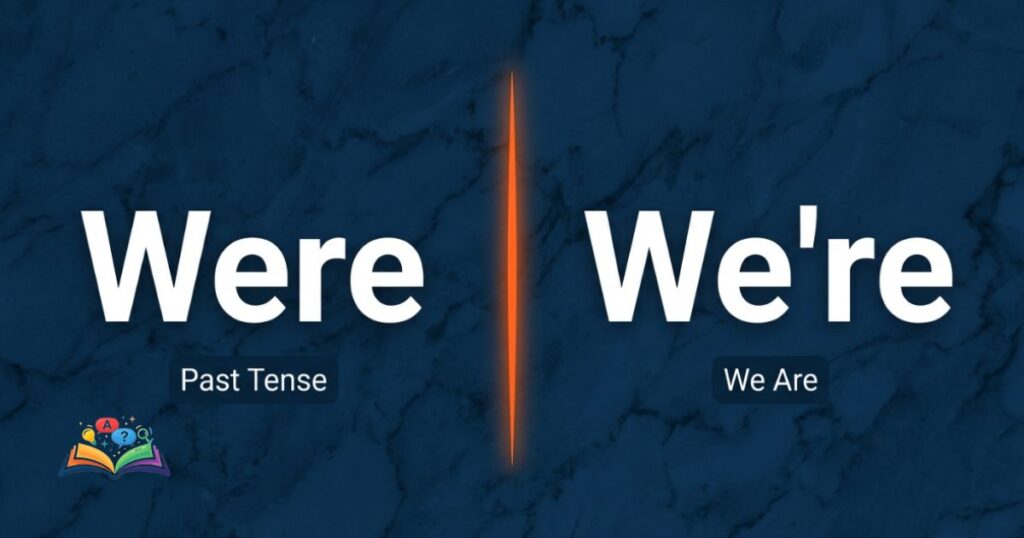
The word we’re is the short form of “we are.” Because it contains a present-tense verb, it always describes something happening right now or an action planned for the immediate future. When writing, think of the apostrophe as a tiny placeholder for the missing letter “a” in “are.”
The table below breaks down how this contraction functions in common American English phrases:
| Complete Phrase | Contraction Form | Sentence Example |
| We are back | We’re back | We’re back from our vacation in California. |
| We are home | We’re home | Call us when you land because we’re home. |
| We are good | We’re good | We’re good to go once the rain stops. |
| We are done | We’re done | We’re done with the project ahead of schedule. |
Understanding the Past-Tense Verb Mechanics of Were or We’re
When we look at the word were without an apostrophe, we are dealing with a past-tense verb. It is a plural form of the verb “to be,” used to describe actions that already happened.
You must use this form whenever your subject is plural, such as “we,” “they,” or specific groups of people and objects. It is also the correct choice for the pronoun “you,” regardless of whether you are speaking to one person or a crowd. Understanding these verb mechanics keeps your timelines straight and prevents confusing your reader about when an event took place.
- Correct: We were in a sentence discussing our old neighborhood.
- Incorrect: We we’re in a sentence discussing our old neighborhood.
- Correct: They were late to the meeting.
- Incorrect: They we’re late to the meeting.
Examining the Subjunctive Mood and Hypotheses Using Were or We’re
The English language changes its rules slightly when we speak about imaginary scenarios, wishes, or things that are not true. This special grammatical setup is called the subjunctive mood.
In standard speech, you might use “was” for single subjects, but conditional sentences require a specific shift. Read the examples below to understand how the past-tense verb functions in hypothetical statements, and see how it differs from other complex verb changes by reviewing our guide on will or would for better sentence flow.
The Subjunctive Rule: Always use were instead of was when expressing a wish or a complete impossibility, even if the subject is singular like “I,” “he,” or “she.”
- Correct: I wish I were a millionaire.
- Incorrect: I wish I was a millionaire.
- Correct: If I were or we’re looking at a map, I would say we are lost. (Using were here establishes the imaginary condition).
Real-World Sentence Contexts Showing the Correct Placement of Were or We’re
Seeing words in action makes it much easier to memorize their patterns. Context clues within a sentence always dictate which option belongs in your draft.
When building your sentences, check the surrounding words for clues about time and identity. If you need to expand your vocabulary beyond tracking verbs, you can check out how plural spelling shifts operate in our breakdowns of thieves or thiefs, alongside similar rules for wolves or wolfs, and even elfs or elves to keep your writing sharp.
- Correct: Were you or we’re you planning to attend the game? (Past action query) → Were you planning to attend the game?
- Correct: We are so proud of you. (Contraction switch) → We’re so proud of you.
- Correct: We are here to help. (Contraction switch) → We’re here to help.
- Correct: We are not participating this year. (Contraction switch) → We’re not participating this year.
Common Written Mistakes and Typographical Confusions of Were or We’re
Typing quickly often causes people to miss critical punctuation, turning a clear sentence into a confusing error. These small slips change the structure of your writing completely.
The most common error is accidentally dropping the apostrophe when you actually mean “we are.” Another frequent mistake involves confusing these two words with “where,” which introduces location into the mix. You can study these specific errors to build better proofreading habits, much like learning to spot tricky variations such as gasses or gases or understanding past-tense vowel shifts like sank or sunk.
- The “Short Form” Illusion: People often write “we were short form” assuming we’re works as a past-tense contraction. It does not. There is no short form for we were.
- The Location Mix-up: Writing “where were or we’re supposed to go” leaves out crucial details. The proper layout is: “Where were we supposed to go?”

Final Clarity on Eliminating Blunders When Writing Were or We’re
Mastering English requires looking at the core function of each word rather than just how it sounds. A quick mental pause before hitting save will protect your work from embarrassing slips.
Keep your edits simple: if you mean a past action, use were. If you mean “we are,” insert the apostrophe for we’re. For deeper insights into cleaning up your text and mastering tricky word matchups, explore our complete correct word usage guide to elevate your communication skills.
Common Questions About the Everyday Mastery of Were or We’re
When Should I Explicitly Use Were or We’re in Professional Writing?
In formal business emails or essays, you should spell out “we are” completely instead of using the contraction we’re. Save the word were for your past-tense statements and formal subjunctive sentences.
Is It Grammatically Correct to Say We’re Instead of We Were?
No, it is never correct to use we’re when you mean “we were.” The contraction always means “we are” in the present tense, so substituting it into past-tense situations disrupts your timeline.
How Do You Pronounce Were or We’re Differently in Spoken English?
The word were rhymes with “stir” or “purr,” using a short, soft vowel sound. The contraction we’re sounds like “weer,” rhyming with words like “clear” or “steer.”
Can You Provide Ten Clear Examples of Were or We’re in Action?
- We’re leaving for New York tomorrow morning.
- The old keys were sitting on the kitchen counter.
- If I were you, I would take that job offer.
- We told them were or we’re not ready yet, so we’re waiting.
- They were the best team in the tournament last year.
- We’re thrilled to announce our new business partnership.
- You were missed at the dinner party last night.
- Let us know when we’re allowed to enter the theater.
- The documents were filed in the wrong cabinet drawer.
- We’re going to need a bigger budget for this project.
Why Do Spellcheckers Frequently Fail to Catch Mistakes Between Were or We’re?
Digital spellcheckers look for real words rather than the specific context of a sentence. Because both terms are spelled correctly in the dictionary, automated tools often miss the error if you swap one for the other.