
If you keep mixing up “fare” or “fair,” you are dealing with one of the most common word confusions in English. These two words sound exactly the same, but they have completely different meanings. That is why phrases like “how did you fare” and “that’s not fair” often get written incorrectly.
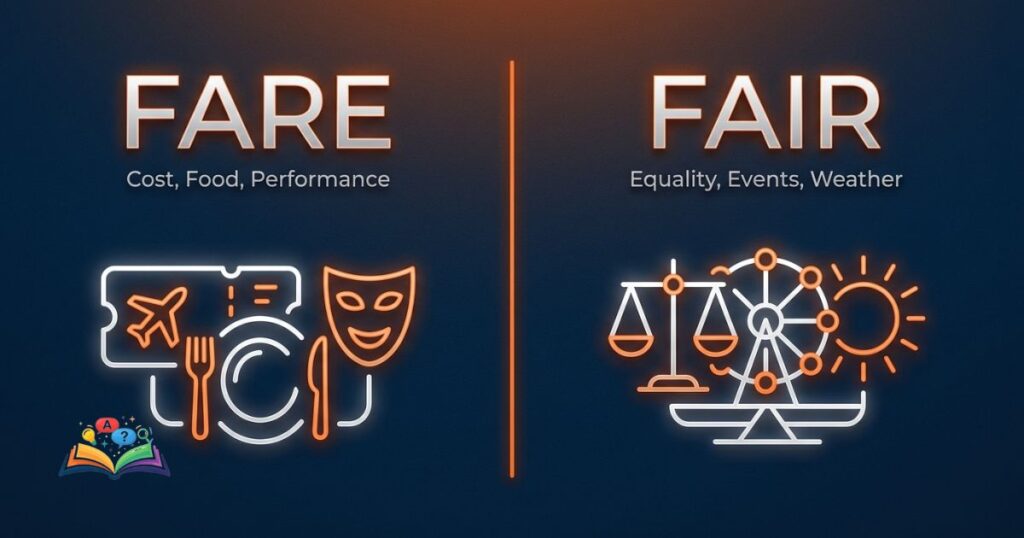
The simple rule is this: “fare” usually relates to cost, food, or how someone performs, while “fair” usually relates to equality, honesty, beauty, or public events. This guide breaks down the real difference, shows common mistakes, and gives easy memory tricks so you can use both words correctly every time.
If you enjoy breaking down confusing English word pairs, this collection of commonly confused English words covers many similar mistakes people make in everyday writing.
Why People Confuse Fare And Fair So Often
“Fare” and “fair” are homophones. That means they sound identical when spoken aloud. In casual conversation, nobody can hear the spelling difference, so many people guess incorrectly when writing.
The confusion gets even worse because both words appear in common expressions. One sentence may use “fare” for performance, while another uses “fair” for justice or equality. A single letter completely changes the meaning.
Here are a few examples:
| Correct Phrase | Why It Is Correct |
| How did you fare? | “Fare” means perform or get along |
| That’s not fair | “Fair” means just or reasonable |
| Bus fare increased | “Fare” means transportation cost |
| The county fair starts Friday | “Fair” refers to a public event |
Writers often make similar sound-based mistakes with words like site vs cite and role vs roll, where pronunciation causes spelling confusion.
What “Fare” Refers To In Everyday English
“Fare” is usually connected to transportation costs, food, or how someone performs in a situation. It works as both a noun and a verb, depending on the sentence.
Many people incorrectly swap it with “fair” because the pronunciation never changes.
Here are the main meanings of “fare”:
| Use Of “Fare” | Example Sentence |
| Cost of transportation | The taxi fare was expensive. |
| Food or meals | The restaurant serves Italian fare. |
| Performance or progress | She fared well during the interview. |
Correct examples:
- How did your team fare in the playoffs?
- Airline fares usually rise during holidays.
- The diner serves simple comfort fare.
Incorrect examples:
- How did your team fair in the playoffs?
- Airline fairs are too expensive.
English spelling confusion often happens when similar sounds carry unrelated meanings, just like peel or peal and flue or flu.
How “How Did You Fare” Changes The Entire Meaning
One of the biggest mistakes people make is writing “How did you fair?” The correct phrase is actually “How did you fare?”
In this context, “fare” means “to perform,” “to succeed,” or “to get along in a situation.” The word has nothing to do with fairness or equality.
Correct examples:
- How did you fare on the exam?
- He fared better after changing jobs.
- The company fared poorly during the recession.
Incorrect examples:
- How did you fair on the exam?
- She faired better than expected.
A quick trick helps here: if the sentence asks how someone performed, survived, or managed, the correct word is almost always “fare.”
This kind of spelling confusion also appears in pairs like loath vs loathe and griefing vs grieving, where one small spelling change alters the entire meaning.
Why “That’s Not Fair” Has Nothing To Do With Fare
When people say “That’s not fair,” they are talking about justice, equality, or reasonable treatment. The word “fair” describes something balanced, honest, or acceptable.
“Fare” does not fit this meaning at all.
Correct examples:
- It’s not fair that she got blamed alone.
- The teacher made a fair decision.
- Everyone deserves fair treatment.
Incorrect examples:
- It’s not fare that he left early.
- That was a fare decision.
“Fair” also has several additional meanings in English:
| Meaning Of “Fair” | Example |
| Honest or equal | A fair agreement |
| Light in color | Fair skin |
| Pleasant weather | Fair skies today |
| Public festival or exhibition | State fair |
Confusing related words is common in English spelling. Similar examples include stationary vs stationery and waisted vs wasted.
Fare Or Fair In Popular English Expressions
Many expressions use “fare” or “fair” in ways that confuse writers. Some phrases are fixed expressions, so changing the spelling instantly makes them incorrect.
The examples below make the difference easier to remember. Pay close attention to how the meaning changes with each word.
“Standard Fare” Vs “Standard Fair”
“Standard fare” is the correct phrase when talking about typical food, entertainment, or content.
Examples:
- The café offers standard breakfast fare.
- The movie was standard action fare.
“Standard fair” is usually incorrect unless discussing an actual fair or festival.
Correct:
- The carnival featured standard fair attractions.
Incorrect:
- The restaurant serves standard fair.
Writers often struggle with similar plural and usage patterns in words like parenthesis vs parentheses.
“Fare Better” Vs “Fair Better”
“Fare better” is the correct phrase because “fare” means perform or succeed.
Correct examples:
- Smaller businesses fared better this year.
- Students fare better with practice.
Incorrect examples:
- Students fair better with practice.
- She fairs better under pressure.
Mistakes like this are similar to spelling confusion in cancelation vs cancellation, where one version looks believable but is less accepted or incorrect in context.
Fare, Fair, Fayre, And Faire: Which One Is Actually Correct?
English includes several old-fashioned or stylized versions of these words, which creates even more confusion online.
Here is the difference:
| Word | Typical Use |
| Fare | Cost, food, performance |
| Fair | Equality, beauty, events |
| Fayre | Decorative old-style spelling |
| Faire | Renaissance or medieval branding |
“Fayre” often appears in business names, bakeries, or food festivals trying to create an old English style.
Examples:
- Village Fayre
- Christmas Fayre
“Faire” is commonly used for Renaissance-themed events.
Examples:
- Renaissance Faire
- Medieval Faire
These stylized spellings are branding choices, not standard modern grammar.
Fare Or Fair For Carnival, Festivals, And Food Events
This topic confuses many writers because both words can appear around events and food.
Use “fair” when talking about a public festival, carnival, or exhibition:
- State fair
- County fair
- Job fair
Use “fare” when talking about food or cuisine:
- Traditional Southern fare
- Festival fare
- Mexican fare
Examples:
| Correct Usage | Explanation |
| We visited the county fair. | Public event |
| The fair served classic carnival fare. | Food offered at the event |
Many sound-alike word pairs create the same kind of confusion, including peeking vs peaking and sweet vs sweat.
Most Common Fare Vs Fair Mistakes In Everyday Writing
Most “fare” and “fair” mistakes happen because people write based on sound instead of meaning. Autocorrect also misses these errors because both words are real English words.
Here are the mistakes seen most often online:
| Incorrect | Correct |
| How did you fair? | How did you fare? |
| That’s not fare | That’s not fair |
| Fair better | Fare better |
| Bus fair | Bus fare |
Social media posts, text messages, and casual emails often contain these mix-ups. Similar spelling problems also appear in words like bingeing vs binging and extravert vs extrovert.
A good proofreading habit is checking the sentence meaning instead of relying on pronunciation.

Simple Memory Tricks To Keep Fare And Fair Separate
Remembering the difference becomes much easier once you connect each word to a visual clue or fixed meaning. These memory tricks work quickly because they link the spelling to a familiar situation.
The two simple connections below help separate “fare” and “fair” in seconds.
The “Taxi Fare” Memory Connection
Think about paying money for transportation.
- Taxi fare
- Bus fare
- Airfare
The word “fare” often relates to payment, travel costs, food, or performance.
Helpful memory line:
“Fare costs money or describes how someone performed.”
This same approach works for confusing word pairs like bolder vs boulder, where a visual connection helps prevent mistakes.
The “Fair And Equal” Memory Connection
Think about justice, equality, or honesty.
- Fair rules
- Fair treatment
- Fair decision
Helpful memory line:
“Fair means equal, honest, or reasonable.”
Another easy association is the phrase “fair and square,” which reinforces the meaning of fairness.
Final Clarity On Fare Or Fair
“Fare” and “fair” may sound identical, but they belong in completely different situations. “Fare” usually relates to cost, food, or performance, while “fair” relates to honesty, equality, appearance, or public events.
A simple meaning check solves most confusion:
- If the sentence involves payment, food, or performance, use “fare.”
- If the sentence involves justice, equality, beauty, or festivals, use “fair.”
The more you connect each word to its meaning instead of its sound, the easier correct spelling becomes.
Common Questions About Fare Or Fair
Is It “How Did You Fare” Or “How Did You Fair”?
“How did you fare?” is correct because “fare” means perform or manage in a situation.
Is “That’s Not Fare” Ever Correct?
No. The correct phrase is “That’s not fair” because “fair” means just or reasonable.
Why Is It Called A Fair But Food Is Called Fare?
A “fair” is a public event or festival, while “fare” refers to food, meals, or cuisine.
What Does “Fare Better” Mean?
“Fare better” means to perform more successfully or achieve a better result.
Can “Fair” And “Fare” Ever Mean The Same Thing?
No. Even though they sound identical, their meanings are completely different.