
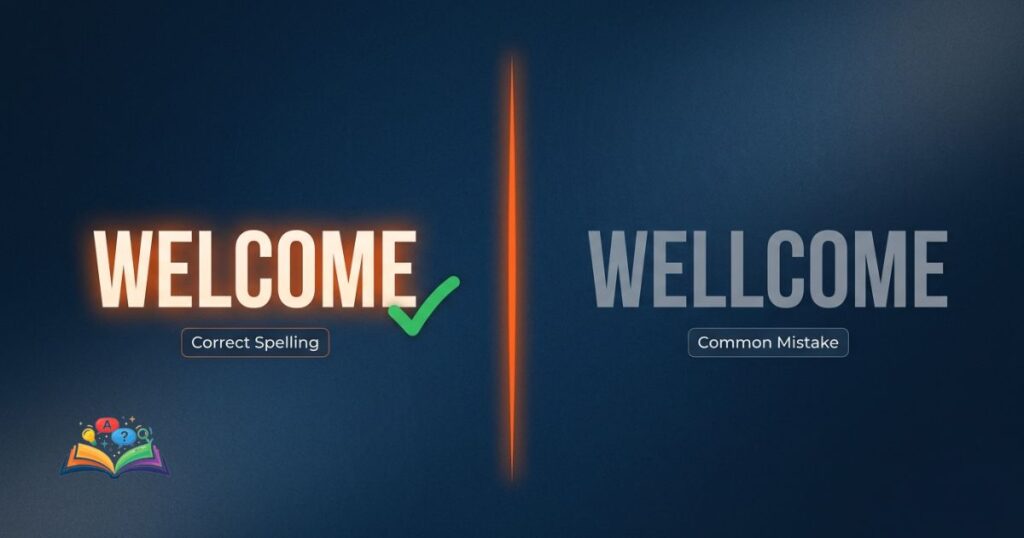
If you are wondering whether to write welcome or wellcome, the correct standard spelling is welcome with a single “l.”
The spelling “wellcome” is a common English error. Because the word sounds like a combination of “well” and “come,” writers frequently insert an extra “l.”
Comparison: Welcome or Wellcome Differences
| Feature | Welcome (Correct) | Wellcome (Incorrect) |
| Status | Standard English | Spelling Error / Historical Surname |
| Number of L’s | Single “l” | Double “l” (Incorrect) |
| Primary Function | Greeting, verb, noun, adjective | Proper noun only (e.g., Wellcome Trust) |
| Example | “You are always welcome here.” | ❌ “You are always wellcome here.” |
Why “Wellcome” Feels Logical for “Welcome” Confusion
The impulse to write wellcome instead of welcome stems from pattern overgeneralization and visual habit.
English features many high-frequency words ending in a double “l”—such as well, full, tell, bell, and call. When typing quickly, the brain naturally defaults to the familiar standalone word “well.” This visual trap causes writers to merge “well” and “come” into a single word without double-checking standard dictionaries.
This type of confusion also appears in other common spelling mistakes like prove vs proove confusion explained, where visual familiarity leads writers to select incorrect word forms.
The Historical Origin of the Word “Welcome”
To understand why the correct spelling is welcome with one “l,” it helps to look at its historical language development.
- The word originates from the Old English term wilcuma, which meant “a desired or pleasing guest.”
- The first part, wil-, derived from “will” or “pleasure,” while cuma meant “comer” or “guest.”
- As Middle English evolved, the prefix shifted phonetically toward “wel-“, but it never adopted the double-L structure of the independent adverb “well.”
This linguistic shift demonstrates how English vocabulary evolves over time, similar to tricky formatting rules like label vs lable correct usage, where standard versions do not always match initial visual assumptions.
Is “Wellcome” Ever Correct Instead of “Welcome”?
In general English vocabulary, writing wellcome instead of welcome is never correct. However, you may occasionally see it capitalized as a proper noun in specific historical contexts:
- The Wellcome Trust: A major global charitable foundation named after Sir Henry Wellcome.
- Surnames and Brand Names: Historical family names or registered businesses.
Outside of specific brand names or proper nouns, using “wellcome” in regular sentences is a direct spelling mistake.
How to Use “Welcome” Across Different Parts of Speech
Unlike rigid words that serve a single purpose, welcome is a highly versatile term that functions across four primary grammatical categories:
- Interjection (Greeting): “Welcome to our house!”
- Adjective (Pleasing or acceptable): “That cool breeze was a welcome change.”
- Verb (To receive warmly): “We welcome new ideas from all team members.”
- Noun (A greeting or reception): “The speaker received a warm welcome.”
Real-World Sentence Examples of “Welcome” and “Wellcome” Errors
Knowing the rule is one thing; seeing welcome or wellcome in action ensures you do not make the mistake in daily communication.
Correct Usage of “Welcome”:
- ✅ “You’re welcome!”
- ✅ “The company will welcome the new CEO next week.”
- ✅ “Constructive criticism is always welcome.”
Incorrect “Wellcome” Mistakes to Avoid:
- ❌ “Thank you for the wellcome gift.”
- ❌ “You are wellcome to stay with us.”
- ❌ “We extended a wellcome response.”
Making subtle spelling errors in professional communication can lower reading credibility, much like writing mistakes explained in occurred vs occured spelling explained.
Common Words Confused with “Welcome” and “Wellcome” Rules
Similar to the welcome or wellcome dilemma, many other English words drop an “l” when combined into compound forms.
Understanding these parallel words helps solidify the single-l rule:
- Already vs. All ready: “Already” uses a single “l”, while “all ready” uses two.
- Almost vs. All most: “Almost” drops the second “l”.
- Always vs. All ways: “Always” uses only one “l”.
- Fulfill vs. Fulfil: Prefixes dropping the extra “l” follow a very similar phonetic pattern to “welcome.”
Pattern confusion also occurs with double consonant variations, as detailed in opening vs openning spelling difference and bearable vs bareable usage guide.
Why Autocorrect Tools Fail to Catch “Wellcome” for “Welcome”
Many writers wonder why spell-check engines do not automatically fix wellcome to welcome.
- Proper Noun Exceptions: Software databases recognize capitalized forms like Wellcome Trust or Sir Henry Wellcome as valid names.
- Dictionary Overlap: If a typo occurs with a capital “W,” autocorrect often assumes you are referring to a brand or surname, letting the error pass through silently into your text.
Memory Shortcuts to Always Remember “Welcome” vs. “Wellcome”
Fixing the habit of writing wellcome requires a simple mental anchor. Use these visual tricks whenever you hesitate between welcome or wellcome:
- The “We Come” Rule: Think of We + Come = Welcome. Neither word contains a double “l.”
- One L for One Warm Greeting: Remind yourself that a genuine welcome only needs one L.
- Picture the Door Mat: Visualizing a standard entryway mat reading WELCOME helps lock the correct spelling into memory.
You can apply similar mnemonic techniques to clarify other commonly misspelled words like wisk vs whisk spelling clarified or echoes vs echos explained.

Final Clarity On Welcome Or Wellcome
The correct spelling is welcome, always with one “l.” The version wellcome is incorrect and should be avoided in all forms of writing.
This mistake happens because of familiar word patterns and assumptions. Once you recognize that “welcome” is not built from “well” and “come,” the confusion disappears.
Stick with the correct form, and your writing will look clean, accurate, and professional.
Common Questions About Welcome Or Wellcome
Is “wellcome” acceptable in British English (UK) instead of “welcome”?
No. Both British English (UK) and American English (US) strictly use welcome with a single “l” as standard grammar.
What is the correct response to “Thank You”: “You’re Welcome” or “You’re Wellcome”?
The correct written phrase is always “You’re welcome” (short for You are welcome). Writing “You’re wellcome” is always incorrect.
Is “welcome” used as both an action verb and a greeting noun?
Yes. “Welcome” can function as a verb (“We welcome you”), a noun (“A warm welcome”), an adjective (“A welcome distraction”), or an interjection (“Welcome!”).