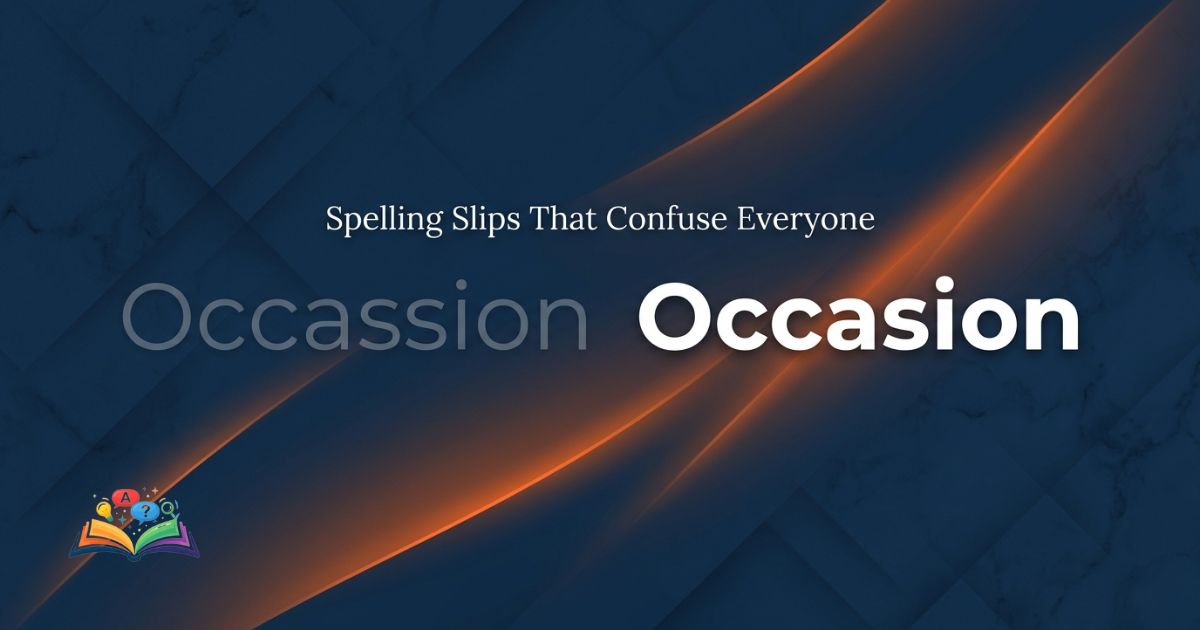
If you are unsure whether “occassion” or “occasion” is correct, the right spelling is “occasion.” The version with a double “s” is a common spelling mistake that appears in emails, school assignments, social posts, and even business writing.
This confusion usually happens because English words with double consonants can feel inconsistent. In this guide, you will see why “occasion” is correct, why “occassion” is wrong, how to remember the spelling, and how to use the word properly in everyday American English.
Why People Commonly Misspell Occasion As Occassion
“Occasion” is one of those words people often type too quickly. Since the word sounds like it could contain two “s” letters, many writers accidentally spell it as “occassion.”
English spelling patterns also add to the confusion. Some words double certain consonants, while others do not. The sections below explain the exact reason this mistake keeps appearing.
| Correct Spelling | Incorrect Spelling |
| Occasion | Occassion |
| Occasional | Occassional |
| Occasionally | Occassionally |
Another reason this mistake happens is because people mix it up with similar spelling patterns. For example, writers also confuse words like occurred vs occured and transferred vs transfered because of double-letter rules.
Occasion Spelling Rules In American And British English
“Occasion” is spelled the same way in both American English and British English. There is no regional spelling difference for this word.
That means US publishers, schools, newspapers, and dictionaries all use “occasion” with one “s” and two “c” letters.
Examples:
- Correct: We celebrated the occasion with a family dinner.
- Incorrect: We celebrated the occassion with a family dinner.
- Correct: Graduation was a special occasion.
- Incorrect: Graduation was a special occassion.
Many spelling mistakes happen because people assume English spelling changes between the US and the UK. That happens with some words, but not this one. Similar confusion appears in words like label or lable and receive or recieve.
For a wider list of commonly confused spellings, check this guide to common English spelling mistakes.
Occasion In Sentences And Everyday English Usage
The word “occasion” usually refers to an event, moment, reason, or special situation. It appears often in conversations, invitations, business writing, and formal speeches.
Below are common ways Americans use “occasion” in daily communication.
| Sentence | Correct Or Incorrect |
| This is a special occasion for our family. | Correct |
| We bought decorations for the occassion. | Incorrect |
| The award ceremony was a memorable occasion. | Correct |
| Her birthday was the perfect occassion to reconnect. | Incorrect |
You may also hear these common phrases:
- Special occasion
- Formal occasion
- Happy occasion
- On occasion
- Social occasion
Spelling mistakes with everyday words are extremely common. Other examples include welcome or wellcome and opened or openned.
Occasion, Occasionally, And Occasional Explained Together
These three words come from the same root word, but they work differently in sentences. Knowing the difference helps prevent spelling and grammar mistakes.
The sections below show how each form is used in standard American English.
Occasion
“Occasion” is a noun. It usually means an event, reason, or moment.
Examples:
- Thanksgiving is an important occasion in the United States.
- We dressed formally for the occasion.

Occasionally
“Occasionally” is an adverb. It means sometimes or from time to time.
Examples:
- I occasionally visit my hometown during summer.
- The restaurant occasionally offers holiday discounts.
Occasional
“Occasional” is an adjective. It describes something that happens sometimes, but not regularly.
Examples:
- He works as an occasional freelance writer.
- We had occasional rain during the road trip.
Writers often misspell related forms too, especially when typing quickly. Similar mistakes appear in words like develop or develope and prove or proove.
Common Wrong Spellings Related To Occasion
“Occassion” is not the only incorrect version of this word. Several misspellings appear online because people rearrange letters or remove consonants.
Here are the most common incorrect forms:
| Wrong Spelling | Why It Is Wrong |
| Occassion | Adds an extra “s” |
| Ocassion | Missing one “c” |
| Ocasion | Missing one “c” and one “s” |
| Occaision | Incorrect vowel placement |
The only correct spelling is:
- Occasion
Mistakes like these happen across many English words. Other examples include seperate or separate, definately or definitely, and congratulations or congradulations.
Words And Phrases Commonly Used With Occasion
“Occasion” often appears in fixed phrases and expressions. Seeing the word in context makes the spelling easier to remember.
Here are some common examples in American English:
| Phrase | Example Sentence |
| Special Occasion | We booked a fancy restaurant for the special occasion. |
| Formal Occasion | A tuxedo is appropriate for a formal occasion. |
| Happy Occasion | The wedding was a happy occasion for everyone. |
| On Occasion | I eat fast food on occasion. |
| Solemn Occasion | Memorial Day is a solemn occasion. |
You can also use “occasion” in professional writing:
- The company hosted an occasion honoring local volunteers.
- The event marked an important occasion in the city’s history.
English spelling mistakes often appear in event-related vocabulary too, including opening or openning and bearable or bareable.
How To Spell Occasion Correctly Every Time
The spelling of “occasion” becomes easier once you focus on its letter pattern. The word contains two “c” letters but only one “s.”
The tips below can help you avoid typing “occassion” again.
Remembering The Single “S” In Occasion
A simple way to remember the spelling is this:
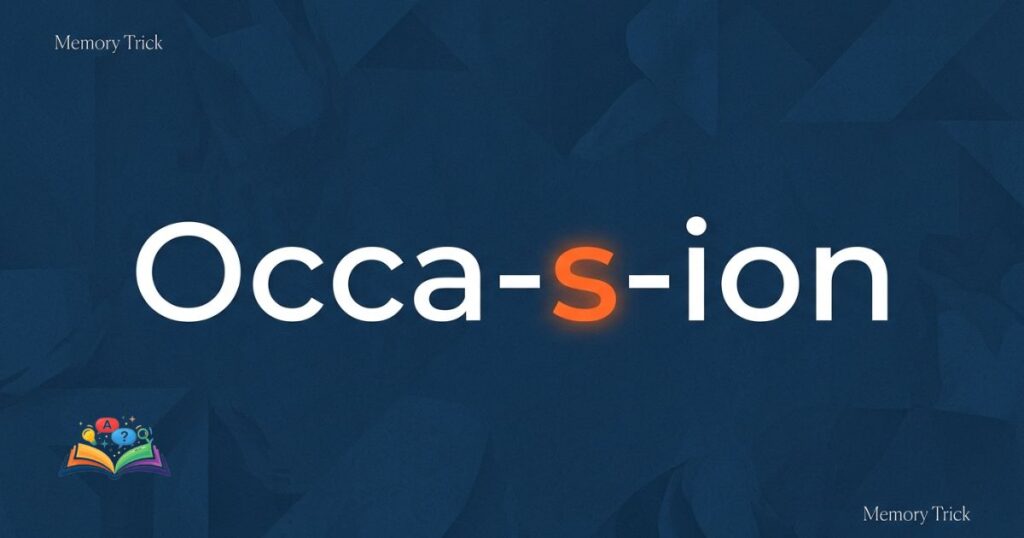
- Occasion = double “c,” single “s”
Think of the structure like this:
- Oc + ca + sion
The ending “-sion” only uses one “s.” Many English words follow the same pattern.
Examples:
- Vision
- Decision
- Occasion
Simple Memory Tricks For Avoiding “Occassion”
These quick tricks can help the correct spelling stick in your memory:
- Think: “One special occasion needs one ‘s.’”
- Say the word slowly: “oc-ca-sion”
- Notice the “-sion” ending instead of “-ssion”
- Proofread event invitations and emails carefully
Writers often confuse repeated letters in English. Similar examples include whisk or wisk and echoes or echos.
Final Clarity On Occassion Or Occasion
“Occasion” is the correct spelling in American English. “Occassion” is always a misspelling and should be avoided in formal and informal writing.
The easiest way to remember the difference is to focus on the ending. “Occasion” uses one “s,” not two. Once you connect the word with the “-sion” pattern, the correct spelling becomes much easier to recognize.
Common Questions About Occassion Or Occasion
Which Is Correct, Occasion Or Occassion?
“Occasion” is correct. “Occassion” is a spelling mistake caused by adding an extra “s.”
Does Occasion Have One S Or Two?
“Occasion” has one “s” and two “c” letters.
Is Occasion A Real Word?
Yes. “Occasion” is a real English word that refers to an event, reason, or special moment.
What Is Another Word For Occasion?
Depending on the sentence, synonyms include event, celebration, moment, ceremony, or opportunity.
What Is A Good Sentence For Occasion?
Example: Graduation was a special occasion for the entire family.
Why Is “Occassion” The Wrong Spelling?
“Occassion” is wrong because standard English spelling uses the “-sion” ending with only one “s.”