
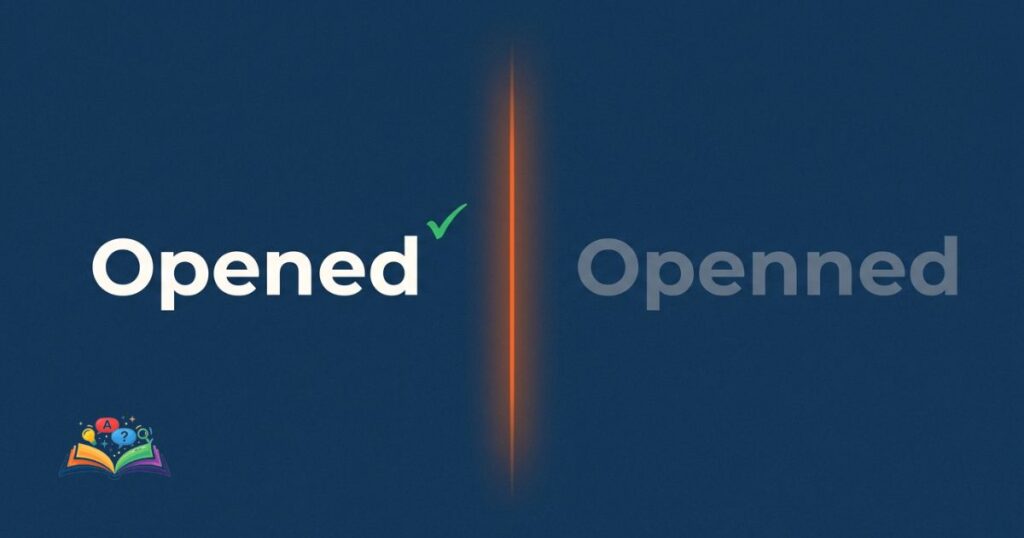
If you are unsure whether “opened” or “openned” is correct, the right spelling is “opened“. The version with double “n” is a spelling mistake that appears often in casual writing, social posts, and student assignments.
This confusion happens because many English words double the final consonant before adding “-ed.” But “open” does not follow that pattern. In this guide, you’ll see why “opened” is correct, why “openned” is wrong, and how to use the word naturally in everyday US English.
Why People Mistakenly Write “Openned” Instead Of “Opened”
“Opened” is the correct spelling. “Openned” is incorrect because the verb “open” does not double the final “n” before adding “-ed.” The standard past tense form is simply “opened.”
Many spelling mistakes happen because English has inconsistent doubling rules. Words like “planned” and “stopped” use double consonants, so people sometimes assume “open” should work the same way.
You can avoid this mistake by paying attention to the syllable pattern and stress of the word.
| Correct Spelling | Incorrect Spelling |
| Opened | Openned |
| She opened the window. | She openned the window. |
| The store opened at 9 AM. | The store openned at 9 AM. |
If spelling mistakes like this confuse you, this guide to common English spelling errors covers similar patterns that cause trouble in everyday writing.
Why “Opened” Is Correct But “Openned” Is Not
The word “open” becomes “opened” by adding “-ed” to the base verb. There is no consonant doubling because the stress pattern does not require it.
English verbs usually double the last consonant only when:
- The word ends in consonant-vowel-consonant form
- The final syllable is stressed
“Open” does not meet that second condition. The stress falls on the first syllable: O-pen.
Compare these examples:
| Base Verb | Correct Past Tense |
| Open | Opened |
| Visit | Visited |
| Listen | Listened |
| Plan | Planned |
| Stop | Stopped |
A similar spelling pattern appears in opening or openning, where adding an extra “n” also creates a mistake.
Is “Opened” A Verb Or An Adjective?
“Opened” can function as both a verb and an adjective depending on the sentence structure. That is one reason many English learners get confused by it.
The sections below show how the word changes meaning based on usage.
“Opened” As A Verb
Most of the time, “opened” works as the past tense of “open.”
Examples:
- He opened the garage door.
- They opened a new coffee shop downtown.
- The teacher opened the discussion with a question.
In all these examples, “opened” describes an action.
“Opened” As An Adjective
Sometimes “opened” describes the condition of something after an action happened.
Examples:
- The opened package was sitting on the table.
- Police inspected the opened container.
- She stared at the opened letter.
This usage is less common in casual conversation. Americans usually prefer “open” in many of these situations.
“The Store Is Open” Or “The Store Is Opened”?
Americans almost always say “The store is open.” Saying “The store is opened” sounds unnatural in normal conversation.
This confusion happens because “open” can describe a current condition, while “opened” usually points to an action that already happened.
When “Open” Is Correct
Use “open” when talking about business hours or availability.
Correct examples:
- The store is open until 10 PM.
- Is the bank open today?
- The restaurant is finally open again.
When “Opened” Fits Better
Use “opened” when describing the action itself.
Correct examples:
- The store opened at 8 AM.
- A new location opened last week.
- The mall officially opened in July.
Mistakes involving missing or extra letters are common in English spelling. Articles like welcome or wellcome show how small spelling changes create incorrect words.
Do I Say “Open” Or “Opened” In Everyday English?
The choice depends on what you mean. “Open” usually describes a state, while “opened” describes an action completed in the past.
Understanding this difference makes your sentences sound much more natural.
Use “Open” For Current Conditions
Examples:
- The door is open.
- Are the stores open today?
- The application period is open now.
Use “Opened” For Past Actions
Examples:
- She opened the email this morning.
- They opened the event with a speech.
- My brother opened the package already.
Writers often confuse verb endings in the same way they confuse words like develop or develope, where an unnecessary extra letter changes the correct spelling.
“Let The Door Be Open” Or “Opened”?
In most situations, “Let the door be open” is the correct and natural phrase in US English.
“Opened” sounds passive and awkward unless you are focusing on the action itself.
Natural Usage With “Open”
Correct examples:
- Let the window be open for fresh air.
- Leave the garage door open.
- Keep the gate open until noon.
Less Natural Usage With “Opened”
These sentences sound unusual:
- Let the door be opened.
- Keep the window opened.
Americans normally reserve “opened” for formal passive constructions:
- The vault was opened by security staff.
Confusion over doubled letters also appears in words like transferred or transfered, where consonant doubling actually is required.
Words And Phrases You Can Use Instead Of “Opened”
Using alternatives can make your writing sound smoother and less repetitive.
Depending on the sentence, several words can replace “opened.”
| Alternative | Best Use |
| Started | Meetings, events, discussions |
| Unlocked | Doors, devices, gates |
| Launched | Businesses, products |
| Began | Activities, speeches |
| Revealed | Information, announcements |
| Unsealed | Envelopes, packages |
Examples:
- The company launched a new app.
- She unlocked the office door.
- The conference began at noon.
You may also notice similar confusion in articles like label or lable, where spelling patterns mislead many writers.

Common Spelling Mistakes Related To “Opened”
“Openned” is not the only spelling error caused by consonant confusion. English contains many words that trick writers into adding or removing letters incorrectly.
These patterns become easier once you notice how English stress rules work.
| Correct | Incorrect |
| Occurred | Occured |
| Whisk | Wisk |
| Bearable | Bareable |
| Prove | Proove |
You can compare these mistakes in related guides:
Final Clarity On Opened Or Openned
“Opened” is the correct spelling in standard English. “Openned” is always considered a misspelling.
The easiest way to remember this rule is simple:
- “Open” does not double the “n”
- Just add “-ed” to form the past tense
Once you connect the spelling to the stress pattern of the word, the mistake becomes much easier to avoid.
Common Questions About Opened Or Openned
Is Openned Ever Used Correctly?
No. “Openned” is not a correct English spelling. Standard dictionaries and grammar guides only recognize “opened.”
What Does “Opened” Mean In English?
“Opened” is the past tense of “open.” It describes something that was unlocked, started, revealed, or made accessible.
Why Open And Not Openned?
The verb “open” does not require consonant doubling before adding “-ed.” That is why the correct form is “opened.”
How Do You Remember The Correct Spelling Of “Opened”?
Think of the base word first:
- Open
- Opened
There is only one “n” in both forms.
What Is The Past Tense Of Open?
The correct past tense of “open” is “opened.”
Is “Opened” Correct In Formal Writing?
Yes. “Opened” is fully correct in both formal and informal English writing.
Is It Correct To Say “We Are Opened”?
In most situations, no. Americans usually say “We are open.”
“We are opened” sounds unnatural unless it appears in a very formal passive sentence.
Correct:
- We are open on weekends.
- The museum is open today.
Less natural:
- We are opened on weekends.