
If you have ever stopped mid-sentence and wondered whether to say nauseous or nauseated, you’re dealing with one of English’s most common usage debates. Both words are widely used today, but they did not originally mean the same thing.
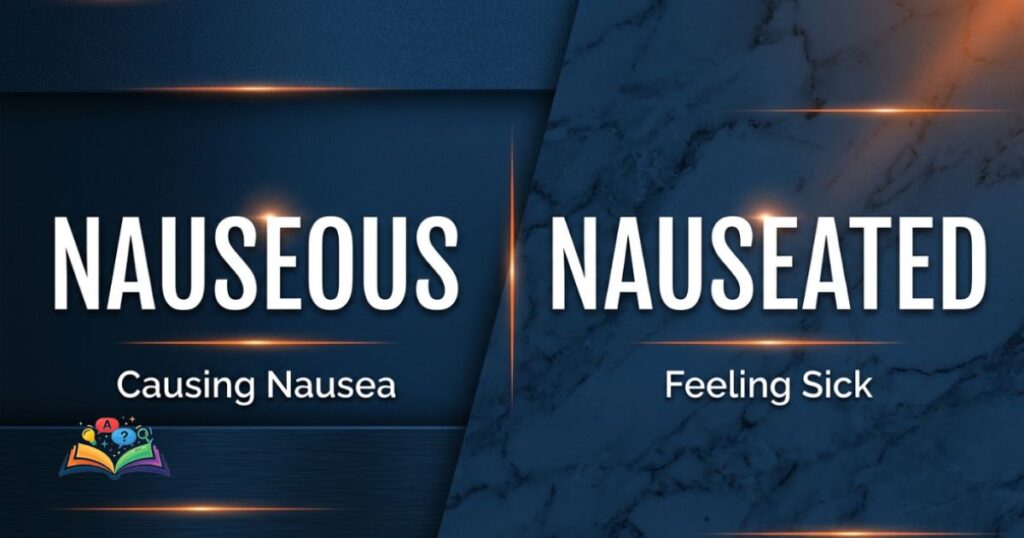
The short version is simple: nauseated traditionally means “feeling sick,” while nauseous originally meant “causing nausea.” Modern English has blurred that distinction, which is why you’ll hear both forms used by native speakers across the United States.
This guide explains the history behind the words, how dictionaries treat them today, which option works best in formal writing, and how to avoid common mistakes.
How Nauseous And Nauseated Developed Different Meanings
Quick Answer: Traditionally, nauseated means feeling sick or ready to vomit, while nauseous means causing nausea. In modern American English, both words are commonly used to describe a person who feels sick, although some editors and grammar experts still prefer the traditional distinction.
The confusion exists because language changes over time. What began as two separate meanings gradually merged in everyday speech.
The word nauseous entered English centuries ago with the meaning “causing disgust or nausea.” If a smell was nauseous, it made people feel sick.
The word nauseated appeared later and specifically described the person experiencing the sensation.
Examples of the traditional distinction:
| Traditional Usage | Correct? |
| The rotten food was nauseous. | ✅ |
| I felt nauseated after the boat ride. | ✅ |
| I felt nauseous after the boat ride. | Traditionally ❌, Modern Usage ✅ |
This type of language shift is similar to other usage changes discussed in our guide to correct word usage and grammar choices.
Why Many Speakers Confuse Nauseous Or Nauseated
The confusion comes from modern speech patterns rather than grammar rules alone.
In everyday American English, people overwhelmingly say:
- I feel nauseous.
- I’m getting nauseous.
- That ride made me nauseous.
Because these expressions are so common, many speakers never encounter the traditional distinction.
Several factors contribute to the confusion:
- Dictionaries now recognize both uses.
- Spoken English often simplifies older distinctions.
- Many people have never seen the words compared side by side.
- Media, television, and social media frequently use nauseous for “feeling sick.”
As language evolves, words often expand beyond their original meanings. Similar shifts have occurred with usage debates such as while vs. whilst and will vs. would.
Should You Say “I Feel Nauseous” Or “I Feel Nauseated”?
If your goal is everyday communication, either phrase will be understood.
If your goal is maximum grammatical precision, many style guides still prefer I feel nauseated.
Everyday Conversation
Most Americans naturally say:
I feel nauseous.
This version sounds normal and conversational.
Examples:
- I feel nauseous after eating too much pizza.
- The motion simulator made me feel nauseous.
- She felt nauseous during the road trip.
Formal Or Technical Writing
In medical, academic, or highly edited writing, many professionals still prefer:
I feel nauseated.
Examples:
- The patient reported feeling nauseated after treatment.
- Several participants became nauseated during testing.
A simple memory trick:
- Nauseated = experiencing nausea
- Nauseous = originally causing nausea
Nauseous Or Nauseated In American And British English
American and British English approach these words somewhat differently.
In the United States, nauseous is commonly accepted for both meanings.
In the United Kingdom, some writers and editors are more likely to preserve the traditional distinction.
This difference resembles other transatlantic language preferences such as mom or mum and math or maths.
Common American Usage
Americans frequently say:
- I’m nauseous.
- She’s feeling nauseous.
- The ride made me nauseous.
Most listeners will not consider these incorrect.
More Traditional British Usage
Some British style guides still favor:
- I feel nauseated.
- The smell was nauseous.
However, modern British usage also shows growing acceptance of nauseous for feeling sick.
Sentences That Show Nauseous And Nauseated In Context
Seeing both words in real sentences makes the distinction easier to remember.
Sentences Using Nauseated
- I became nauseated during the turbulent flight.
- She felt nauseated after the medical procedure.
- The strong medication left him nauseated.
Sentences Using Nauseous
Traditional meaning:
- The odor from the dumpster was nauseous.
- The spoiled milk produced a nauseous smell.
Modern meaning:
- I feel nauseous after riding the roller coaster.
- She felt nauseous during the long bus trip.
Side-By-Side Comparison
| Sentence | Traditional Preference |
| I feel nauseated. | ✅ Preferred |
| I feel nauseous. | ✅ Accepted Modern Usage |
| The smell was nauseous. | ✅ Traditional Meaning |
| The smell was nauseated. | ❌ Incorrect |
Common Writing Mistakes Involving Nauseous And Nauseated
Several mistakes appear regularly in student papers, business writing, and online content.
Mistake #1: Assuming One Word Is Always Wrong
Many people believe nauseous is incorrect when describing a sick person.
That is no longer true in modern American English.
Mistake #2: Ignoring Audience Expectations
Formal audiences may still expect the traditional distinction.
When precision matters, nauseated is often the safer choice.
Mistake #3: Using The Words Interchangeably In Technical Contexts
Medical and scientific writing tends to favor accuracy over conversational usage.
For that reason, many healthcare professionals continue using nauseated.
Language debates like this are similar to discussions around dove or dived, shrank or shrunk, and spelled or spelt, where accepted usage varies by region and context.
Alternative Words For Feeling Nauseous Or Nauseated
Sometimes a different word fits the situation better.
Common alternatives include:
- Sick
- Queasy
- Ill
- Unwell
- Carsick
- Seasick
- Woozy
- Upset stomach
Examples:
- I feel queasy after the boat ride.
- She became ill during the flight.
- He felt sick after eating spoiled seafood.
Choosing the simplest word often improves clarity.

How Dictionaries And Style Guides Treat Nauseous Or Nauseated
Modern dictionaries generally recognize both meanings of nauseous.
Most major dictionary entries note that:
- Traditional usage reserves nauseous for something that causes nausea.
- Modern usage commonly applies nauseous to someone experiencing nausea.
Many style guides acknowledge the shift while recommending nauseated for formal contexts.
This reflects a broader pattern in English. Similar usage discussions appear in guides covering criteria or criterion, master’s or masters, and aid or aide.
Choosing The Right Word Based On Audience And Context
The best choice depends on where and how you’re writing.
Use Nauseated When:
- Writing academic papers
- Writing medical content
- Writing professional reports
- Following traditional style rules
Use Nauseous When:
- Speaking casually
- Writing conversational content
- Posting on social media
- Reflecting natural American speech
Think about your audience first.
This approach works for many usage decisions, including farther or further, sell or sale, and payed or paid.
Final Clarity On Nauseous Or Nauseated
If you remember only one rule, remember this:
Nauseated traditionally means feeling sick. Nauseous traditionally means causing sickness.
In modern American English, however, I feel nauseous is widely accepted and commonly used.
For everyday conversation, either phrase works.
For formal or highly edited writing, nauseated remains the safer and more precise choice.
Common Questions About Nauseous Or Nauseated
Is It Correct To Say I Feel Nauseous Or Nauseated?
Yes. Both are accepted in modern American English, although nauseated is traditionally more precise.
Why Do People Say Nauseous Instead Of Nauseated?
Because common usage gradually expanded the meaning of nauseous to include feeling sick.
Can I Say I’m Feeling Nauseous?
Yes. This is one of the most common expressions used by native English speakers.
What Is The Correct Way To Say Nauseous?
Traditionally, nauseous describes something that causes nausea. Modern usage also allows it to describe someone feeling sick.
What Is It Called When You Feel Like Throwing Up?
The sensation is called nausea.
What Does Nauseated Mean?
Nauseated means experiencing nausea or feeling sick to your stomach.
Is Nausea The Same As Nauseous?
No. Nausea is the condition or feeling. Nauseous is an adjective describing a person or thing.
Do I Say I’m Nauseous Or Nauseated?
Either is acceptable in modern English. Nauseated is generally more precise.
What Is Another Word For Nauseated?
Common alternatives include queasy, sick, ill, and unwell.
How Do British People Say Nauseous?
British English uses both forms, though some writers still favor the traditional distinction between nauseous and nauseated.