If you are unsure whether “accomodate” or “accommodate” is correct, the right spelling is accommodate. The version with one “c” is a common spelling mistake that appears in emails, school assignments, business writing, and online searches.
This confusion happens because the word has double letters in the middle, and many people forget that “accommodate” needs both double “c” and double “m.” This guide explains the correct spelling, pronunciation, sentence usage, synonyms, and memory tricks that make the word easier to spell correctly every time.
For more confusing English spellings, check this guide on common English spelling mistakes.
Why So Many People Misspell Accommodate
“Accommodate” is one of the most commonly misspelled words in English. The biggest problem is remembering where the double letters belong. Many writers accidentally remove one “c” or one “m,” which creates incorrect spellings like “accomodate” or “acommodate.”
People also confuse the word because English spelling rules are not always predictable. Similar spelling issues happen with words like occurred vs occured and definitely vs definately.
| Correct Spelling | Incorrect Spellings |
| Accommodate | Accomodate |
| Accommodate | Acommodate |
| Accommodate | Accomadate |
| Accommodate | Acommodation |
Another reason for confusion is pronunciation. Many speakers do not strongly pronounce both double letters, so the spelling becomes harder to remember when writing quickly.
How To Pronounce Accommodate Without Confusing The Spelling
The standard US pronunciation of “accommodate” is:
uh-KOM-uh-dayt
Even though the pronunciation sounds smooth, the spelling still requires:
- Double “c”
- Double “m”
This mismatch between sound and spelling causes many typing mistakes.
Here is a simple breakdown:
| Part | Sound |
| Ac | uhk |
| com | KOM |
| mo | uh |
| date | dayt |
Words with repeated consonants often create spelling confusion in English. Similar patterns appear in separate vs seperate and receive vs recieve.
How To Use Accommodate Correctly In Everyday English
“Accommodate” usually means:
- To provide space or room for someone
- To adjust to someone’s needs
- To fit or hold something
- To help make a situation easier
The word appears often in schools, workplaces, hotels, healthcare settings, and customer service.
Correct Usage Examples
- The hotel can accommodate up to 300 guests.
- Our teacher accommodated students with extra time during the exam.
- The conference room accommodates large teams comfortably.
- The airline accommodated passengers after the delayed flight.
Incorrect Usage Examples
- The hotel can accomodate 300 guests.
- We tried to accomodate the schedule changes.
Business writing often contains spelling mistakes in formal words. That is why editing matters, especially with words like government vs goverment and environment vs enviroment.
Sentences That Show The Correct Use Of Accommodate
Seeing the word inside complete sentences makes the spelling easier to remember. It also helps you understand the different ways “accommodate” works in real communication.
Workplace And Professional Sentences
- The manager accommodated the employee’s medical appointment.
- The company accommodated remote workers during renovations.
- The office can accommodate more desks after the redesign.
School And Everyday Sentences
- The teacher accommodated students with visual impairments.
- This backpack can accommodate a 16-inch laptop.
- The restaurant accommodated our large family group.
Incorrect Sentences
- The office can accomodate more desks.
- The restaurant accomodated our group.
Double-letter spelling mistakes are extremely common in English. You can see similar confusion in tomorrow vs tommorow and transferred vs transfered.
Accommodate Synonyms That Fit Different Contexts
“Accommodate” works in many situations, but sometimes another word sounds more natural depending on the context.
| Context | Better Alternative |
| Helping Someone | Assist |
| Making Adjustments | Adapt |
| Providing Space | Hold |
| Meeting Needs | Support |
| Flexible Scheduling | Arrange |
Sentence Comparisons
| With Accommodate | With Synonym |
| We accommodated the schedule. | We adjusted the schedule. |
| The venue accommodates 500 people. | The venue holds 500 people. |
| The company accommodated customer requests. | The company supported customer requests. |
Writers often mix up similar-looking words while searching for alternatives. That happens with words like which vs wich and their vs thier.
Easy Memory Tricks To Spell Accommodate Correctly
The easiest way to remember “accommodate” is this:
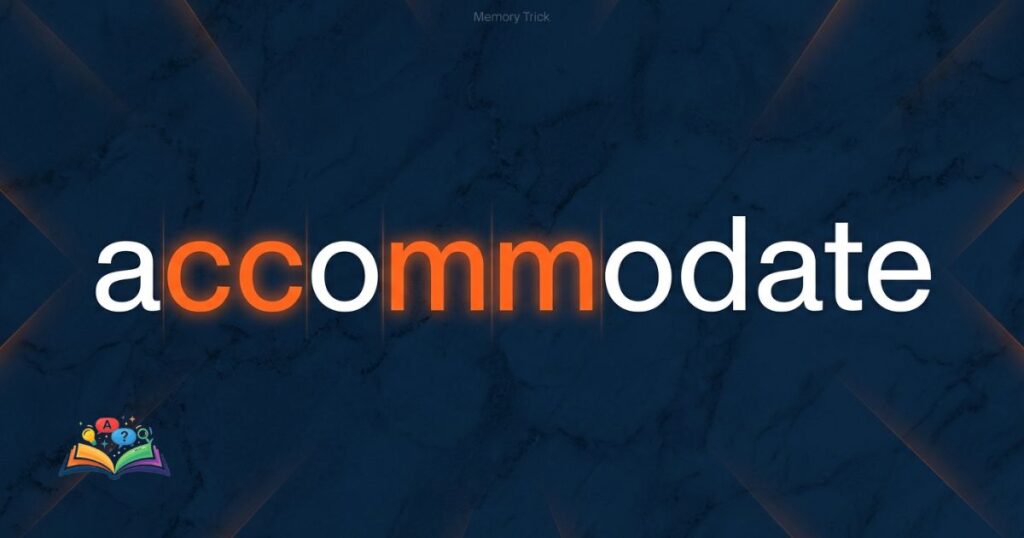
Two C’s, Two M’s
That simple rule prevents most spelling mistakes.
Here are a few additional memory tricks:
- Think: “acCOMModate” has room for extra letters.
- Break it into chunks: ac + com + modate
- Repeat the double letters out loud while typing.
Visual Memory Trick
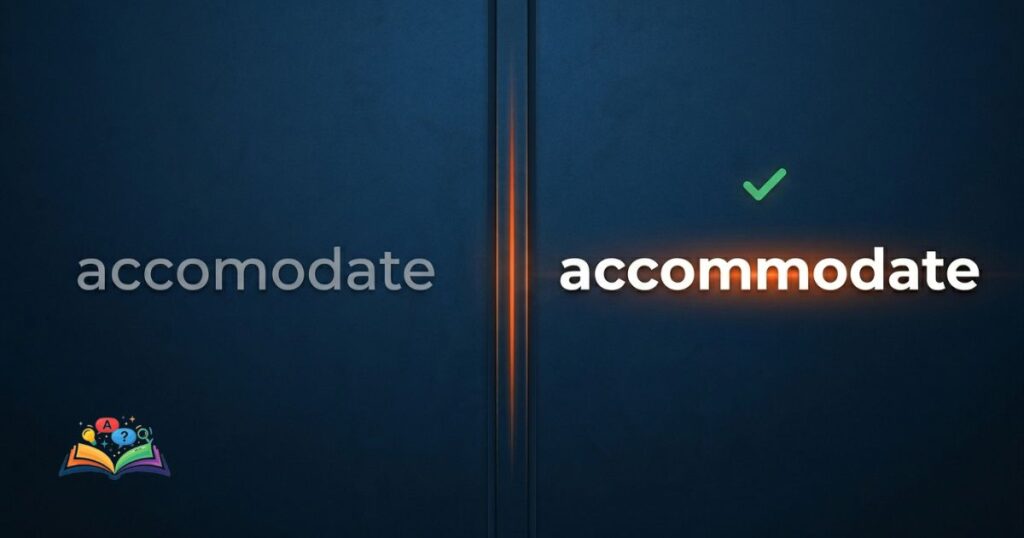
| Wrong | Correct |
| accomodate | accommodate |
The correct word looks longer because it needs:
- CC
- MM
English spelling confusion often happens when repeated letters are involved. Similar patterns appear in opening vs openning and welcome vs wellcome.
Is “Accommodation” Also Commonly Misspelled?
Yes. “Accommodation” is another heavily misspelled word.
The correct spelling is:
- Accommodation
Common mistakes include:
- Accomodation
- Acommodation
- Accommadation
Just like “accommodate,” the noun form also requires:
- Double “c”
- Double “m”
| Correct | Incorrect |
| Accommodation | Accomodation |
| Accommodation | Acommodation |
The spelling confusion is similar to words such as occasion vs occassion because repeated consonants are easy to overlook.
Accommodate In British And American English
Some English words change spelling between US and UK English, but “accommodate” stays the same in both versions.
| US English | UK English |
| Accommodate | Accommodate |
That means:
- “Accomodate” is incorrect in American English.
- “Accomodate” is also incorrect in British English.
Unlike words with regional spelling differences, this word follows one accepted spelling worldwide.
Common English Spelling Mistakes Similar To Accommodate
Words with double consonants create some of the most common writing mistakes in English.
Here are a few examples:
| Correct | Incorrect |
| Publicly | Publically |
| Until | Untill |
| Whisk | Wisk |
| Label | Lable |
| Congratulations | Congradulations |
You can also compare similar spelling patterns in:
- publicly vs publically
- until vs untill
- whisk vs wisk
- label vs lable
- congratulations vs congradulations
These mistakes happen because English pronunciation does not always match spelling patterns perfectly.
Final Clarity On Accomodate Or Accommodate
“Accommodate” is the correct spelling. “Accomodate” is always incorrect in standard English.
The easiest way to remember the word is:
- Two C’s
- Two M’s
Once you connect the word with that pattern, the spelling becomes much easier to remember in emails, school writing, professional communication, and everyday typing.
Common Questions About Accomodate Or Accommodate
Is Accomodate Correct?
No. “Accomodate” is a misspelling. The correct spelling is “accommodate.”
Why Is Accommodate So Hard To Spell?
The word contains double “c” and double “m,” which many people forget while typing quickly.
What Is The Meaning Of Accommodate In Simple Words?
“Accommodate” means to provide space, adjust to someone’s needs, or make something fit comfortably.
Is It “Accommodate Your Schedule” Or “Accommodate To Your Schedule”?
“Accommodate your schedule” is the correct phrase in most situations.
What Is A Better Word For Accommodate?
Depending on the context, alternatives include:
- Adjust
- Support
- Assist
- Adapt
- Hold
Are There Common Misspellings Of Accommodate Besides “Accomodate”?
Yes. Common misspellings include:
- Acommodate
- Accomadate
- Acommodation
How Do Americans Spell Accommodate?
Americans spell it as “accommodate,” which is also the standard spelling in British English.
What Is The Opposite Of Accommodate?
Common opposites include:
- Refuse
- Reject
- Deny
- Oppose